Building Relationships That Compound | Tim Bismeyer
Building Relationships That Compound
By IsleFlow With Insights From Tim Bismeyer
THE NUMBERS TELL a story about growth. Ten years ago, a Vancouver property management company gave Corview Construction Ltd. a $2,000 renovation, essentially a test. Last year, that same relationship alone generated $4 million in business.
The math tells a different story about growth. Approximately 80% of Corview’s revenue comes from repeat clients, with over a dozen relationships lasting more than a decade. This represents a fundamentally different business model built on compounding relationships rather than constant client acquisition.
The counterintuitive driver? Strategic specialization in a market that offers abundant opportunities to diversify.
For 35 years, Corview Construction Ltd., a 10-person team, has maintained an unwavering focus on commercial tenant improvements: offices, retail, and industrial. That discipline has created defensible expertise, enabled consistent quality delivery, and built relationships that compound over time. Tim Bismeyer, owner and president, leads Corview’s operations and explains how focus and the discipline to maintain it create sustainable, predictable growth.
How $2,000 Becomes $4 Million: The Compounding Value of Relationships
Their relationship with the property management company tells you everything you need to know about how Corview operates and why it takes a different approach from others.
The deliberate positioning starts before any bid is submitted. “I start every meeting with a new client with an upfront conversation: I’m not here for the quick buck or the fast game. I’m here to build a relationship with you for hopefully years to come,” Bismeyer explains.
This isn’t marketing dialogue. It’s intent that shapes every decision about how Corview engages with clients, delivers projects, and builds its reputation.
That property management relationship began a decade ago with a small renovation. “They were trying us out,” Bismeyer notes. “And we delivered on it. It went well.”
The progression for Corview was systematic rather than dramatic. Small projects built trust. Trust led to larger opportunities, and consistent delivery strengthened the relationship. What began as a test renovation became one of their most valuable client relationships.
This trajectory repeats across Corview’s client base.
Consider what this model creates. Customer acquisition costs shrink dramatically when most revenue comes from existing relationships. In fact, Corview operates with no marketing budget. When relationships generate 80% of revenue, traditional marketing spending becomes unnecessary. Sales cycles compress when you’re already the trusted contractor, and predictable revenue enables strategic planning and long-term investment in capabilities.
What makes this possible? “Even in the corporate world, everybody is a person,” Bismeyer says. “And treating people as such goes a long way in building trust.”
Personal relationships matter, but they don’t generate millions of dollars on their own. The foundation is capability. Specifically, the ability to consistently solve client problems at a high level comes from specialization.
Maintaining 80% repeat business over 35 years requires more than relationship skills. It requires the discipline to build defensible expertise and the courage to decline opportunities that would dilute it.
Specialization as a Moat
Vancouver’s construction market offers abundant opportunity. For contractors, the instinct for residential projects, infrastructure work, mixed-use developments, and new construction is often to bid on everything available. Corview does the opposite.
“There are lots of opportunities, so it’s easy to get distracted by them and over-diversify,” Bismeyer explains. “When you do that, it naturally leads to a decrease in product quality delivery.”
The choice is unwavering. Corview places its attention exclusively on commercial tenant improvements: offices, retail, and industrial. This decision isn’t about limiting revenue. It’s about creating the conditions for sustainable growth through defensible expertise.
Deep expertise enables better problem-solving. When you’ve completed hundreds of office tenant improvements, you’ve encountered most scenarios. You know how different building systems interact, understand permit nuances, and can anticipate challenges before they become problems.
Repeat exposure compounds knowledge. Each project builds institutional understanding that becomes harder for competitors to replicate the longer you stay the course. Naturally, quality consistency creates trust.
When clients know you deliver excellence in your domain every time, you become the default choice, not the vendor who needs to prove themselves with each bid. “Keeping with what we do best enables us to deliver the greatest possible product for our clients,” Bismeyer notes. “And that leads to repeat business.”
Strategic focus creates another compounding effect that most contractors overlook. When teams work consistently in the same domain, they develop deep expertise. That expertise makes them more valuable and more engaged. The result is employee retention at Corview that is significantly higher than the construction industry average.
This matters more than it might seem, as institutional knowledge stays in-house. Teams learn client preferences, building quirks, and decision-making processes. That continuity becomes part of the value proposition clients pay for. When the same project managers and superintendents work with the same property management companies year after year, efficiency improves, and trust deepens.
The discipline to maintain this concentration was instilled by the founder. “I was mentored by John Oille, the founder of the company, and he instilled in me the importance of relationships from day one,” Bismeyer explains.
But Oille’s legacy isn’t just relationship philosophy. It’s the discipline to maintain focus for 35 years, even when the market offers seemingly attractive diversification opportunities.
After three and a half decades in commercial tenant improvement, Corview has built knowledge and relationships that would take competitors years to replicate. They understand the Vancouver commercial market intimately. They know the landlords, the buildings, the permit processes, and the subcontractor ecosystem.
That expertise enables them to compete with larger general contractors that may have more resources but less specialized expertise. The competitive advantage isn’t just about what Corview knows. It’s about what they’ve chosen not to pursue.
However, specialization creates a vulnerability. What happens when your core market shifts? The question becomes whether you abandon your strategy or adapt within it.
How to Evolve When Markets Shift: The Show Suite Strategy
Vancouver’s office market is experiencing volatility. Commercial landlords face challenges in attracting tenants. Vacancy rates create pressure.
For many contractors, the response would be to chase new work. Pursue various projects and diversify into new sectors. Corview did something different.
Rather than abandon commercial tenant improvement, they went deeper. They identified an unmet need within their existing client base.
Landlords struggling to attract tenants needed show suites, model spaces that help lease vacant floors. But they needed budget clarity before committing to the investment and standard tender processes came too late in their planning cycle.
Corview developed a pre-construction budgeting service for show suites, providing detailed cost projections prior to formal tender. “Being able to come alongside a commercial landlord and offer them pre-construction budget pricing helps with their success in their planning and in finding future tenants,” Bismeyer explains. “In turn, we get invited to bid on these projects.”
The show suite strategy demonstrates how to adapt to market shifts without diluting attention. It deepens existing relationships rather than chasing new sectors.
Corview is solving problems for clients they already know and trust. It leverages existing expertise, since pre-construction budgeting for commercial spaces requires the deep knowledge Corview has built over 35 years. This is adaptation within competency, not diversification outside it.
The approach shifts positioning from vendor to advisor. By providing value before formal bids, Corview strengthens relationships beyond project execution. It creates new project opportunities from the existing client base rather than requiring constant new client acquisition.
This protects the repeat revenue model during market downturns. When you’ve spent decades building relationships and expertise in one domain, market adaptation happens through deepening client value, not abandoning what you’ve built.
The alternative, diversifying into residential or infrastructure when office work slows, might generate short-term revenue. But it would dilute the expertise and consistency that created those long-standing client relationships.
Operational adaptation follows the same principle. Corview has a relatively young team with significant experience, which, as Bismeyer notes, gives it a unique ability to quickly adapt to the changing landscape in commercial construction. The question is how to adapt without losing direction.
AI tools provide part of the answer. Corview uses large language models (LLMs) for estimating and takeoffs, organizing documentation for clients, trades, and consultants. The tools still need supervision and cross-checking, but they’ve increased efficiency in core operations.
The practical application reveals both the thinking and an unexpected advantage. Because Corview is zeroed in on commercial tenant improvements, the AI learns from consistent, domain-specific data across hundreds of similar projects. Project teams create dedicated LLM channels for specific projects, uploading drawings and spec sheets. “We can ask the program to pull different information from it and have conversations with it,” Bismeyer notes.
There’s significant drive time in commercial construction. Teams now use LLMs during that time to discuss projects and build their knowledge. “It helps increase their knowledge of the projects, which in turn helps them answer questions from sub-trades and clients.”
Corview also uses AI software for automatically inputting notes, scheduling into calendars, creating task lists, and tracking due dates. AI adoption supports what Corview already does, but makes it better, faster, and more efficient, without expanding into new domains.
“As we go about our business, we look for opportunities to propel people forward and to build them up,” Bismeyer notes, describing Corview’s philosophy of “edify,” which means to build others up.
That long-term orientation enables the patience required for relationship and specialization strategies, where sustainable advantage comes from deepening expertise rather than chasing immediate opportunities.
What 35 Years of Discipline Proves
The framework is deceptively simple. Specialization creates defensible expertise, driving consistent, high-quality delivery. Quality builds client trust, which in turn generates repeat business. Repeat business creates predictable revenue that enables long-term investment back into specialization. Each element reinforces the others, and the cycle compounds over decades.
Corview’s track record demonstrates what sustained focus creates over time. When landlords face market volatility, deeper client relationships through show suite budgeting provide new opportunities within existing expertise. When AI tools become available, they enhance core operations rather than enable expansion into new service lines. When talented teams develop deep expertise, retention improves because people value the mastery that comes from focused work.
The approach requires patience, since quick pivots into new markets might generate faster revenue. But sustainable competitive advantage comes from depth rather than breadth.
Every contractor makes strategic choices about where to put their effort and resources. Corview’s 35 years show what happens when that effort remains consistent, as specialized expertise becomes a competitive advantage, and discipline becomes sustainable growth. Client relationships deepen into partnerships that span decades.
The question for construction leaders is straightforward. Where have you built your competitive advantage?
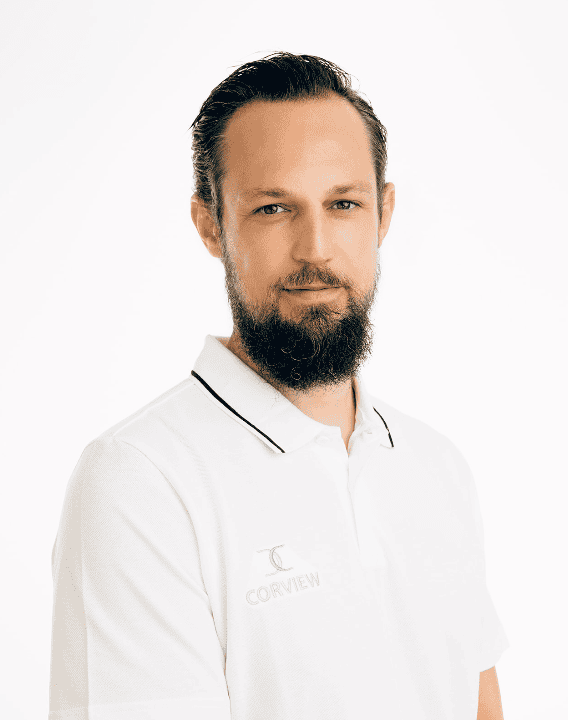
Tim Bismeyer – With more than seventeen years in the construction industry, Tim joined Corview mid-career and quickly stood out for his commitment to quality and excellence. His drive to deliver high standards and consistent results ultimately led him to take over the business from its founder, where he continues to build on that legacy. Today, he leads Corview with a focus on lasting client relationships and dependable project delivery.
About the author:
Robert Puharich is the founder of IsleFlow Content Studio Inc. and author of Building Brilliance. He helps construction firms build the trust, authority, and credibility that makes them the first call, not just another bid.

Related reading: our guide to construction content marketing, construction case studies that win commercial bids, and the commercial authority stack framework.