The AI Data Center Gold Rush: Becoming the Safe Choice for Hyperscale Work
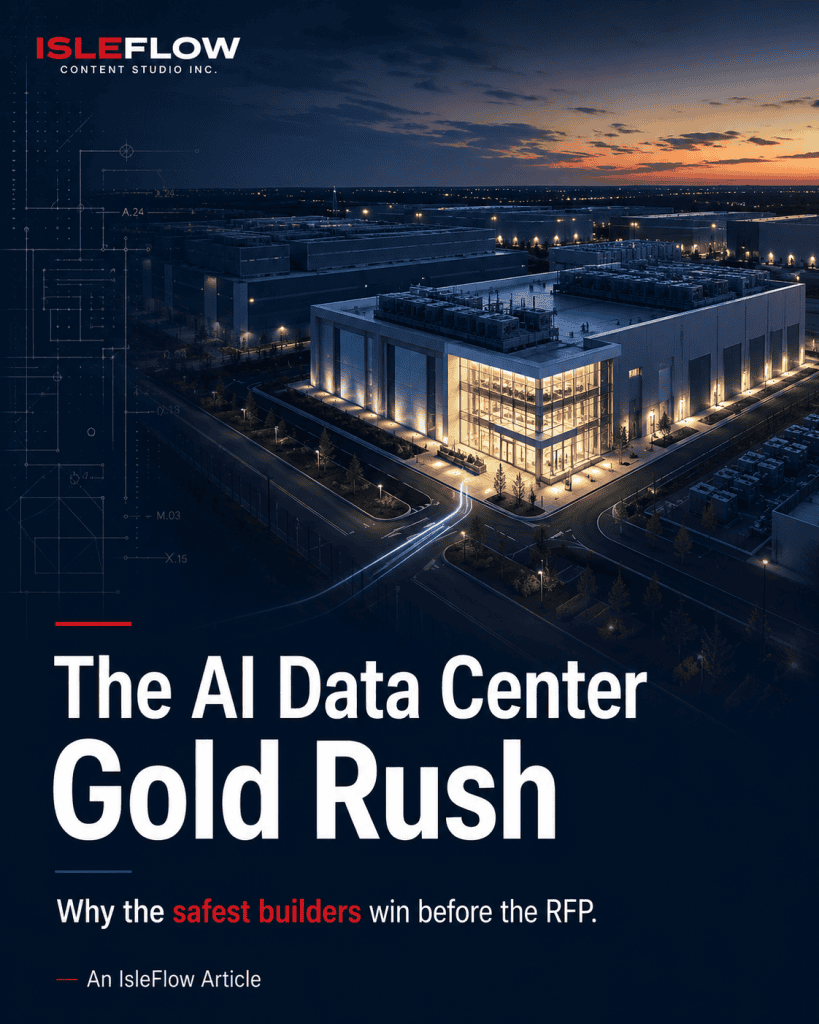
The capital flowing into AI infrastructure is unlike anything the building industry has seen in a generation. Hyperscalers are committing hundreds of billions to data center buildouts, and the contractors positioned to capture that work are facing a market that rewards something most firms have never been asked to prove before: the ability to be trusted with a project that cannot fail. Nearly half of the data centers planned for 2026 in the United States are now delayed or canceled, not because builders lack technical skill, but because the market cannot tell which firms have the judgment to navigate grid constraints, regulatory opposition, and supply chain volatility that are derailing project after project. In that environment, the firms winning hyperscale contracts are not the ones with the most cranes. They are the ones that procurement teams already trust before the RFP is issued.
Key Insights
- Nearly half of U.S. data centers planned for 2026 face delays or cancellations, with grid interconnection queues stretching three to seven years in most major markets.
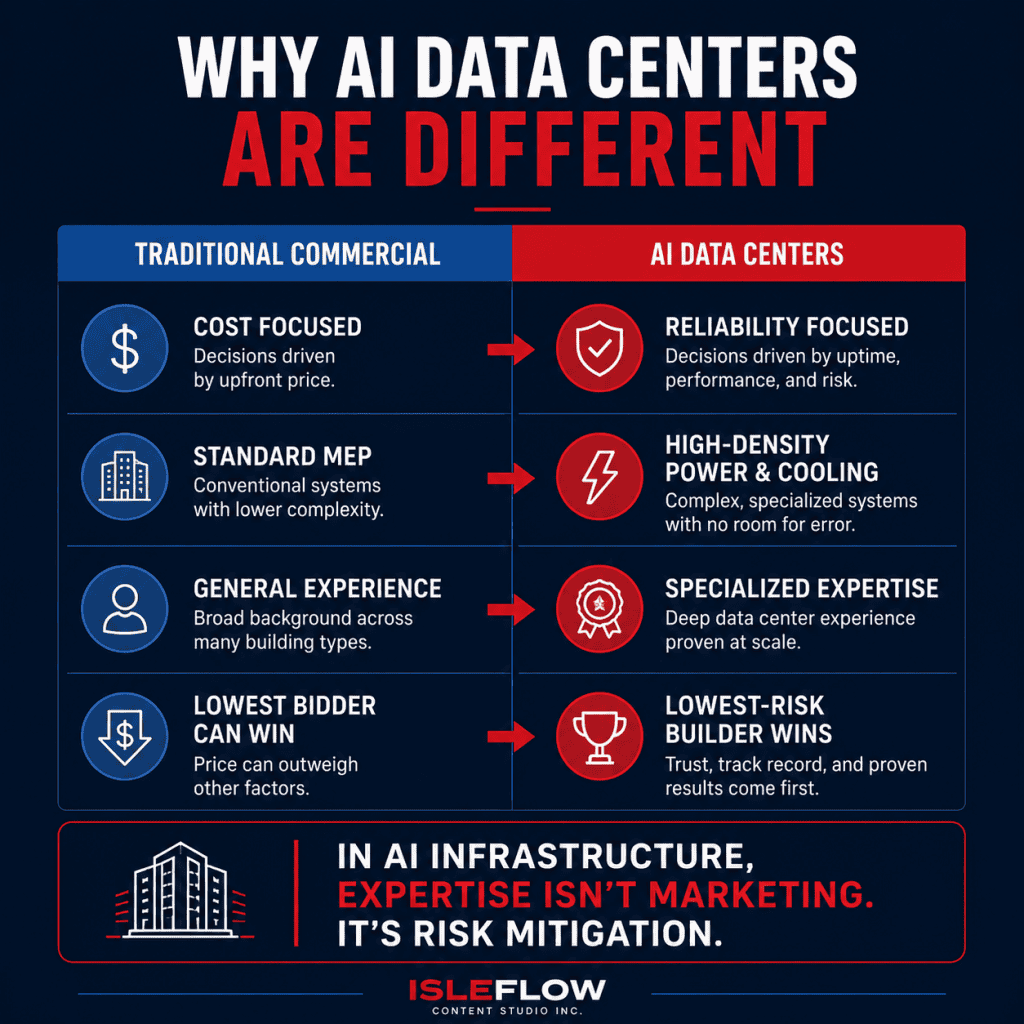
- Procurement for AI infrastructure has shifted from price and speed to risk management, and the firms getting the calls are the ones who can document their ability to navigate what others cannot.
- The Safe Choice Advantage separates firms that get shortlisted before the RFP from those forced to compete on price after it is issued.
The Safe Choice Advantage is what separates a firm that gets the call from a firm that gets the RFP. It describes the market position a construction firm occupies when procurement teams at major developers have already categorized it as a low-risk choice before any formal bid process begins. It is not built on longevity or firm size. It is built on visible, documented expertise such as published case studies and named frameworks, as well as executive perspectives that give buyers something to point to when justifying the shortlist decision internally. In a market where the cost of contractor failure on a mission-critical project runs into hundreds of millions of dollars, the procurement calculus is not “who is most capable” but “who is safe to choose.” The Safe Choice Advantage is the documented authority infrastructure that answers that question before the RFP is ever written.
Why the Fastest Builder Is No Longer the Obvious Choice
Procurement for large-scale AI infrastructure has changed, and not gradually. The firms that dominated early data center work got there by moving fast, coordinating complex trades, and hitting tight commissioning windows. Those capabilities still matter. But they are no longer the criteria that puts a firm on a preferred vendor list.
According to Sightline Climate, nearly half of planned U.S. data center capacity for 2026 is delayed or at risk of cancellation. The reasons are structural, not project-specific. They fall into three areas that procurement teams at Meta, Google, and Amazon now treat as the defining test of whether a contractor belongs on their shortlist.
Grid and power interconnection have become the critical path on most of these projects. Utility interconnection queues across major U.S. markets now stretch anywhere from three to seven years, according to Data Center Knowledge. Projects are stalling not because of on-site execution failures, but because the firms managing them did not understand the power procurement timeline early enough, or could not navigate the interconnection process with enough sophistication to compress it.
Regulatory opposition and litigation have escalated sharply. Opposition groups delayed or blocked close to $100 billion in data center investment in a single quarter of 2025, according to Faegre Drinker. Organized litigation playbooks, previously aimed at wind and solar projects, have shifted directly to data centers. The firms that understand this dynamic and can help owners anticipate and navigate it are worth more to a developer than a firm that simply has a larger crew.
Supply chain volatility compounds both problems. Long-lead electrical equipment and specialized cooling systems carry procurement windows of six to twelve months or more. Contractors who do not know when to initiate ordering, and how to protect against substitution risk, are a liability on a $500 million program.
The developer evaluating a shortlist for a new campus is not asking which firm is fastest. They are asking which firm has already navigated all three of these problems and can prove it.
Technical Excellence Is the Entry Fee, Not the Prize
Every firm bidding at this level has BIM. Every firm has AI scheduling tools and a project history it can reference. Technical competence is the baseline for being considered, not the reason a contract is awarded.
This is where most capable mid-tier firms stall. They have done the work, they have the experience, and they cannot understand why they are not getting the call. The answer is rarely capability. It is almost always visibility and authority.
Industry analysts tracking this market identify fewer than ten firms globally with the capability to lead a large mission-critical project from groundbreaking to live operations, and most of them are running at or near capacity. The largest cloud developers maintain approved vendor lists built on years of familiarity, published track records, and executive-level thought leadership that signals judgment, not just execution. A firm with genuine project experience but no published authority presence does not compete on the same terms as one that has been visible in the right conversations for the past three years.
The Safe Choice Advantage describes the position a firm reaches when it has built enough documented authority in mission-critical risk management that procurement teams see it as the lowest-risk choice before a single bid is submitted. It is not a reputation earned through longevity. It is an authority infrastructure built through content, frameworks, and published expertise that makes a firm’s judgment visible and citable during the independent research phase that precedes every major procurement decision.
For firms with genuine capability and limited market recognition, the Commercial Authority Stack is the mechanism that builds it.
Three Ways to Build Safe Choice Authority Before the Next RFP
Document your risk frameworks and give them names. Every firm that has successfully navigated a complex grid interconnection or managed a regulatory challenge has developed an internal process for doing it. Most of those processes exist only in the heads of project executives and are never written down in a form that buyers can evaluate. A structured case study documenting how your firm identified a grid phasing conflict eighteen months before it would have become a schedule failure, and what your protocol for resolving it looks like, is worth more in a mission-critical procurement evaluation than a general reference list. Give that protocol a name. Write it down. Publish it. Buyers who encounter a firm that has formalized its approach to the exact problems they are most afraid of do not forget it.
Publish a perspective on the risks your buyers are already researching. The teams running hyperscale procurement programs are reading everything they can find about contractor qualification, grid interconnection challenges, and data center construction risk management before they issue an RFP. A whitepaper on managing the power interconnection gap, published under the name of a senior executive at your firm, positions that person as a peer-level thinker in the exact conversation those buyers are already having. It does not read as marketing. It reads as demonstrated expertise. The difference between a firm that arrives at the shortlist stage with a project portfolio and one that has already contributed meaningfully to the industry conversation on mission-critical procurement is not subtle. The Safe Choice Advantage is built through moments like this one.
Publish a book. This is the capstone of the authority infrastructure, not because it generates immediate inquiries, but because it changes the category a firm occupies in the mind of a risk-averse procurement executive. A published book on mission-critical project delivery, written by the firm’s principal or CEO, says something no project brochure can replicate. It tells a procurement executive that this firm has thought carefully and at length about the problems they are about to face, and has documented that thinking in the most credible medium available. When two firms of comparable capability are being evaluated for a program where a delay costs the owner hundreds of millions of dollars, the one whose executive wrote the book on the subject is not in the same category as the one who did not.
What Winning Before the RFP Actually Looks Like
Consider a structural contractor with $50 million in annual revenue and a strong track record in complex industrial work. They have completed two mid-scale data center projects. They want to break into hyperscale work, but every RFP response goes up against the same firms on every shortlist. They are technically qualified. They are not known.
Now imagine that firm’s CEO publishes a whitepaper on grid-phase risk management, documenting how to protect a data center schedule when interconnection queues run three years behind. The paper draws on two completed projects and lays out a specific sequencing protocol the firm developed internally. It circulates in LinkedIn discussions among data center developers. A procurement manager at one of the major cloud companies reads it while researching contractors for a regional expansion.
Six months later, when that developer assembles a shortlist, that firm receives a call it would not otherwise have gotten. Nothing changed about the quality of their work. What changed is that the Safe Choice Advantage was visible in exactly the one place it needed to be, during the independent research phase that precedes every serious procurement decision.
Frequently Asked Questions
How do construction firms get on a hyperscale contractor shortlist?
The largest cloud and AI developers build their approved vendor lists well before any RFP is issued. Getting onto those lists requires documented experience in mission-critical project delivery, evidence of risk management capability, and a visible market presence that gives procurement teams a basis for trust before formal evaluation begins. Firms that have published case studies, whitepapers, or books on relevant topics are consistently better positioned during this pre-procurement phase than those relying on project references alone.
What is causing so many AI data center projects to be delayed in 2026?
The primary causes are grid interconnection timelines, which now run three to seven years in most major U.S. markets, combined with surging regulatory opposition and supply chain constraints on long-lead electrical equipment. These are structural market conditions, not on-site execution failures, which means the firms best positioned to win work are those who have developed and documented frameworks for navigating each one.
What does it mean to have the Safe Choice Advantage in mission-critical construction?
The Safe Choice Advantage is reached when a firm has built enough published authority in mission-critical risk management that procurement teams categorize it as a low-risk choice before a formal bid process begins. It is earned through structured case studies, technical whitepapers, and published executive perspectives that address the specific risks buyers are most focused on.
How does published thought leadership connect to winning construction contracts?
Commercial buyers at major AI infrastructure companies complete most of their contractor evaluation independently, before engaging any firm directly. The content a firm has published shapes how procurement teams categorize it during this pre-contact phase. A firm with documented expertise visible in the right places arrives at formal evaluation already trusted. A firm with equivalent capability and no published presence must build that trust from scratch under competitive pressure.
Related reading: our guide to construction content marketing and construction case studies that win commercial bids.
Ready to position your firm as the Safe Choice for the hyperscale contracts your capability already qualifies you for? At IsleFlow Content Studio Inc., we work with construction executives to develop the case studies, whitepapers, and published books that build mission-critical authority before the next RFP is issued. If your firm has the project outcomes and the expertise, we can document them at the standard that gets you on the shortlist before formal procurement begins.
We guarantee your satisfaction. If you are not completely satisfied with your content, we will work with you until it meets your expectations.
About the author:
Robert Puharich is the founder of IsleFlow Content Studio Inc. and author of Building Brilliance. He helps construction firms build the trust, authority, and credibility that makes them the first call, not just another bid.
