
How to Write a Construction Case Study That Wins $1M+ Contracts
How to Write a Construction Case Study That Wins $1M+ Contracts
Most construction firms have strong project outcomes. They have schedule recoveries, budget saves, complex coordination wins, and buildings that delivered exactly what the owner needed. What they do not have is a structured way to convert that project history into documented evidence that commercial buyers can evaluate before the RFP is issued. This article covers the PSI Framework, a three-part structure for construction case studies that translates project experience into the commercial evidence evaluators need when they are deciding which firms belong on a best-value shortlist.
Key Insights
- Best-value procurement evaluators are not assessing whether a contractor can build. They are assessing whether the firm’s decision-making can be trusted when conditions change on their specific project.
- A project gallery documents what was built. A construction case study documents how the project was handled when something unexpected happened and what your team did about it.
- The PSI Framework gives commercial buyers the three components they use to justify including a firm on a best-value shortlist above lower-priced competitors: a documented Problem, a specific Solution, and a measurable Impact.
What Commercial Buyers Are Actually Evaluating
Commercial owners and developers awarding $1M+ contracts are not building shortlists based on square footage completed or the number of projects in a portfolio. They are evaluating risk. The central question beneath every shortlist decision is whether a contractor’s team can manage their budget, timeline, and reputation when conditions change, and conditions always change on a commercial project of that scale.
The best-value procurement model formalizes this evaluation by requiring contractors to submit documented past performance alongside their bid price. The contractors who perform well in that evaluation are not always the most technically capable firms in the market. They are the firms that have documented their past performance in a form that gives evaluators something specific to assess. A project description that says “delivered on time and within budget” gives an evaluator nothing to work with. A documented account of a specific complication and a measured outcome gives them the evidence they need to justify a recommendation internally.
The firms that navigate this shift successfully share a common characteristic. According to Construction Business Owner, Paul King of McCarthy Building Companies described the transition this way: buyers have moved toward evaluating contractors on “a solid approach, strong team and well-thought-out execution plan coupled with a fair fee, rather than falling for flashy presentations that are limited on substance or depth.” The shift is not rhetorical. It requires a different kind of content than most construction firms currently produce.
For construction firms building a content strategy around documented authority, the Commercial Authority Stack framework describes how documented past performance functions as the Proof layer of a firm’s credibility architecture. The Proof layer is the base that every other content asset draws from, and none of them carry as much weight without it.
The PSI Framework: A Three-Part Structure for Commercial Case Studies
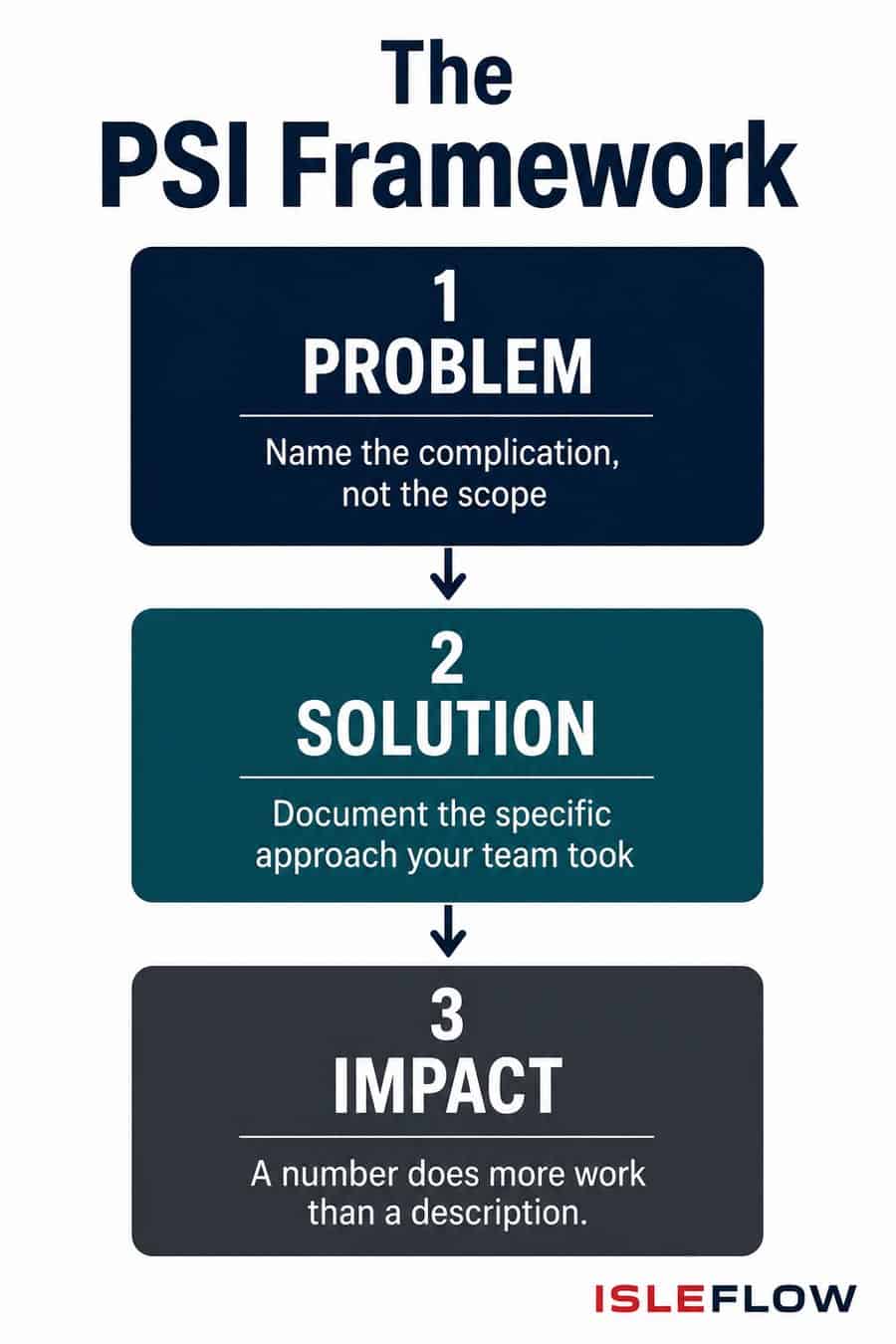
The PSI Framework is a three-part structure for construction case studies that converts project experience into commercial evidence. The three components are the Problem that required your team’s intervention, the Solution your firm designed and delivered, and the measurable Impact your client received. A case study built on this framework gives commercial buyers the structured documentation they use to justify selecting a higher-priced firm over a lower-priced competitor in a best-value evaluation.
Part 1: The Problem
The Problem identifies the specific high-stakes challenge the project presented. This is not the project scope. It is the complication within the scope that required your team to make a decision that a less experienced contractor might not have made correctly.
A tight urban site requiring active coordination with adjacent occupied buildings. A mission-critical handover in a healthcare or data center facility where a delay would trigger significant downstream costs. A geotechnical condition discovered during excavation that required redesigning the foundation system mid-project. A regulatory requirement that emerged after design and forced a re-sequencing of the entire phasing plan.
The Problem should be specific enough that a project manager with experience in that building type would immediately recognize the situation. Vague language about “scheduling challenges” or “coordination complexity” gives a buyer nothing to evaluate. Specific language gives them a concrete signal about the category of difficulty your firm navigates competently. Write the Problem in two to three sentences. The goal is not to dramatize. It is to establish precisely the nature of the complication so that a buyer with a similar upcoming challenge can recognize its relevance.
Part 2: The Solution
The Solution describes the specific steps your team took to address the Problem. This is the component where most construction firms underperform, and it carries the most weight with experienced evaluators.
A standard project description says: the team managed the schedule closely and coordinated with the owner throughout. A well-constructed Solution says: the team restructured the project phasing into four activation zones, maintained a functional perimeter around occupied operations at all times, and implemented a daily close-out protocol that eliminated the coordination lag that had been delaying subsequent trades. These two sentences describe the same general approach. They produce entirely different impressions in an evaluator’s mind.
The Solution documents your firm’s methodology, not your values or commitment to quality, but the specific technical and logistical decisions that produced an outcome a less experienced contractor would not have achieved. For the complete five-part narrative structure that surrounds these components, the Recovery Story Format developed in How to Write Construction Case Studies That Win Commercial Bids provides the full implementation guide. Keep the Solution to three to five sentences in a standard case study, or two sentences in a bid package insert.
Part 3: The Impact
The Impact converts technical success into business value. It is the component commercial buyers weigh most heavily and the one most construction firms write most vaguely.
A number does more work than a description. “Substantial completion was achieved four days ahead of the revised schedule” outperforms “the project was delivered on time.” “A redesign and accelerated delivery sequence compressed the overall timeline by two weeks at no additional cost to the client” gives an evaluator something specific about your firm’s capacity to recover from a setback. When the Impact can be connected to a business outcome the owner can calculate against the bid price, the case study becomes evidence of financial stewardship, not just construction performance.
Connect the Impact directly to the decision documented in the Solution. The logical chain from Problem to Solution to Impact is what transforms a project narrative into a defensible argument. An evaluator who can trace that logic is not left wondering whether the outcome was the result of your firm’s competence or favorable conditions.
The PSI Framework: Construction Case Study Template
- Problem: What specific high-stakes challenge did this project present? (2-3 sentences; name the complication, not the project scope)
- Solution: What specific steps did your team take to address it? (3-5 sentences; name the approach and its immediate effect on the project)
- Impact: What measurable outcome did the client receive? (2-3 sentences; a specific number does more work than a description)
Five Practices for Capturing the Story Behind a Project
Writing the case study is the visible part of the work. The harder part is capturing the right material before the project details fade.
Conduct the post-mortem interview at project close. The window for capturing a high-quality case study is thirty to sixty days after substantial completion. A project manager who navigated a genuine complication can describe the decision logic clearly at month two. By month six, the same manager will describe the situation as “the usual coordination issues” and the approach as “we figured it out.” Interview the team while the specifics are available. These questions tend to produce the most usable material: What was the most significant problem this project presented? What options did you consider before choosing your approach? What would have happened if you had handled it differently?
Document the messy middle, not just the finished product. Photography and documentation of the problem state, the process, and the complication are often more commercially useful than photos of the completed building. A buyer evaluating your firm is not primarily interested in the outcome they can see on a walkthrough. They are interested in the conditions your team managed to produce it.
Capture the owner’s voice. A specific, problem-focused testimonial from the client that names a particular situation rather than offers general praise carries weight that a contractor’s own description cannot replicate. “The contractor identified a coordination risk three weeks before it would have become a delay and resolved it before our project management team was aware of it” is something your firm’s marketing content cannot produce independently.
Track the metrics evaluators actually use. Safety incident rates, schedule adherence, final cost versus contracted cost, and client retention across project types are the numbers that appear in best-value evaluation criteria. According to Thornton & Lowe, when firms write case studies for tender and bid submissions, evaluators want evidence of similar work delivered at similar scale, with complex requirements managed and measurable outcomes documented. Firms that track these metrics systematically across projects can populate the Impact component with verified figures rather than estimates.
Build the authority bridge. Every case study should end with one sentence linking to a related published resource from your firm. The whitepaper that addresses the relevant project type. The article that covers the specific complication category. The published book that positions your executive’s perspective on the field. The authority bridge extends the commercial value of the case study by connecting a documented project outcome to a body of published thinking, giving a buyer who wants to understand your approach a direct path to it.
From One Case Study to a Bid-Ready Library
According to Edify Content, B2B case studies can close six- and seven-figure contracts if they are written to address the specific evaluation criteria buyers use. In commercial construction, those criteria are documented past performance, measurable outcomes, and evidence of sound judgment when conditions changed on a real project. The PSI Framework addresses all three, in a format that every commercial construction firm can produce from the project history they already have.
Three well-constructed case studies covering different project types, complication categories, and delivery methods will outperform a larger library of project descriptions in any pre-RFP shortlisting process. The goal is not volume. It is coverage across the complication categories most common in your target project type. A buyer researching your firm before a solicitation is looking for one documented situation that resembles their upcoming project. Three well-constructed case studies across meaningfully different scenarios give most commercial buyers that match.
The firms that appear on best-value shortlists before the first conversation are not the firms with the most impressive portfolios. They are the firms whose project history is documented in a form that commercial buyers can evaluate. Published consistently as part of a broader content strategy, strong case studies become the foundation of the pre-RFP shortlisting position that a competitor without documented authority cannot replicate in time to compete for any individual contract.
Frequently Asked Questions
What is the PSI Framework for construction case studies?
The PSI Framework is a three-part structure for writing construction case studies that converts project experience into commercial evidence. The three components are the Problem that required your team’s intervention, the Solution your firm designed and delivered, and the measurable Impact your client received. A case study built on the PSI Framework gives commercial buyers the documented past performance evidence they need to justify selecting a higher-priced firm in a best-value evaluation.
How long should a construction case study be for a proposal or bid submission?
A proposal insert version should fit on a single page, with each component reduced to one or two sentences. A website version runs 400 to 600 words. A longer version, up to 1,000 words, is appropriate when the Problem involved multiple interrelated complications and the buyer audience has the technical background to evaluate that level of detail. Length should be determined by the complexity of the Problem being documented, not by the desire to appear thorough.
How do construction case studies help win best-value contracts?
Best-value procurement requires contractors to submit past performance evidence alongside their price. Case studies that document a specific complication, your team’s response, and a measurable outcome give evaluators the structured evidence they need to justify recommending a higher-priced firm over a lower-priced competitor. A project gallery shows what was built. A case study shows how your team performed when conditions changed, which is the specific evidence category best-value evaluators are looking for.
How many construction case studies does a commercial firm need?
Three to five case studies covering different project types, complication categories, and delivery methods will outperform a larger library of project descriptions for pre-RFP shortlisting purposes. The goal is coverage, not volume. A buyer researching your firm before a solicitation is looking for one documented situation that resembles their upcoming project. Three well-constructed case studies across meaningfully different scenarios give most commercial buyers the match they need to move your firm to the shortlist.
IsleFlow Content Studio works with construction executives to build the documented authority that earns a place on the commercial shortlist before the bid is issued. From PSI Framework case study libraries to published executive books, we help construction firms turn the expertise inside their project history into the commercial evidence that buyers are looking for. The firms that start building that library today are putting distance between themselves and the competition while the competition is still deciding whether to begin.
About the author:
Robert Puharich is the founder of IsleFlow Content Studio and author of Building Brilliance. He helps construction firms build the trust, authority, and credibility that makes them the first call, not just another bid.
