
Why the Best BIM Firm Rarely Wins the Bid

The pattern is familiar to almost every technical construction leader who has competed for major commercial work. Your firm has invested significantly in BIM, VDC, and digital coordination capabilities. Your preconstruction team can demonstrate reduced RFIs, schedule certainty, and clash detection workflows that save owners real money. You lose the bid anyway, often to a competitor whose proposal had better graphics but whose technology investments don’t come close to matching your own.
Key Insights
- BIM capability is now a baseline procurement requirement on major commercial projects, not a differentiator. Firms still treating it as one are competing on the wrong variable.
- The firms winning high-value technical work are not necessarily the most technologically advanced. They are the ones who have made their expertise visible and verifiable to owners who cannot evaluate BIM depth on their own.
- Converting technical excellence into bid-winning authority requires a deliberate mechanism. This article calls that mechanism the Authority Engine.
The gap is not one of capability. It is one of visibility. Technical excellence that lives inside your firm’s workflows but never surfaces as documented, public-facing expertise is invisible to the decision-makers who award work. Owners evaluating best-value proposals are not assessing your software stack. They are assessing how clearly you understand their problems and whether your approach to solving them is credible enough to trust.
This is the Silent Expert problem. Your firm knows more about managing complex commercial construction risk with digital tools than most of the market. That knowledge is not reaching the people it needs to reach. The Authority Engine is the mechanism that closes that gap, turning internal technical expertise into public-facing assets that shape how owners perceive your firm long before the formal procurement process begins.
The Technical ROI Gap
BIM is no longer a differentiator in most commercial construction markets. It is a requirement. According to PlanRadar’s analysis of BIM adoption in the United States, 74 percent of contractors in the country now use BIM on their projects. Technology that was a competitive advantage for early adopters is now standard practice on most commercial bids, and owners know it.
This creates a structural problem for technically advanced firms. The firms that invested early, built deep VDC capability, and developed proprietary workflows are now competing against firms with substantially less investment and output quality, on a level playing field as far as most owners are concerned. The technology that was supposed to be a differentiator has become the Commodity Trap for the entire sector.
The underlying issue is perception. Owners selecting a construction partner for a major commercial project are not, in most cases, positioned to evaluate the difference between a Level 2 and Level 3 BIM delivery. They are not assessing clash detection rates or model coordination hours. They are assessing confidence and whether this firm understands their project’s risks well enough to be trusted with them. Technical proposals answer that question poorly. They describe capability without translating it into owner outcomes, and owners read them accordingly.
The Trust Deficit
The challenge runs deeper than proposal writing. CMAA’s research on owner-centric BIM identifies a consistent pattern in how construction firms and their clients talk past each other on technology. Owners want to understand how digital tools serve their interests as building operators and long-term asset managers. Most contractors are delivering contractor-centric BIM narratives to owners who are asking owner-centric questions. The firm describing its coordination methodology is answering a question the owner was not asking.
The result is a trust deficit that technical specification alone cannot close. Owners who cannot evaluate BIM capabilities directly default to the proxies they can evaluate: reputation, visible expertise, and the quality of the narrative a firm has built around its work before the RFP arrives. That is the terrain where technically excellent firms consistently underinvest, and where the Authority Engine operates.
The Authority Pivot
The firms winning the most valuable technical construction work are not the ones with the best technology. They are the ones who have become the recognized authority on how that technology should be used. This is a meaningful distinction.
Doing BIM means deploying digital tools competently to manage coordination, reduce risk, and deliver on schedule. Defining BIM means publishing perspectives on how digital construction should work, what owners should expect from it, and what the firms that do it well actually do differently. One position earns a firm a seat at the evaluation table. The other earns a different kind of conversation, one where the owner is already predisposed toward a particular firm before the formal process begins.
What Technical Authority Actually Is
Technical authority in construction is not about having more certifications or a larger software investment. It is about being the firm that shapes the conversation in your market. The contractor that owners and developers reference when they want to understand what good looks like. The firm whose principals get called before an RFP is issued because the owner wants their perspective on how to structure the project.
That position is not awarded by doing excellent work in private. It is built through documented expertise that accumulates in public over time. A whitepaper on how digital twins reduce operational costs in healthcare facilities. A detailed case study on how preconstruction BIM coordination prevented significant change orders on a complex institutional project. An executive book on the future of digital construction that positions your firm’s leadership as the definitive voice on the subject. Each of these assets does something a proposal cannot do. It provides credible, independently verifiable evidence of expertise that reaches owners before they are ready to select a firm.
The Power of Documented Frameworks
Most technically advanced construction firms have developed proprietary approaches that are genuinely superior to what the market offers. Their preconstruction coordination process has been refined over years of complex projects. Their approach to digital twin handover is more rigorous and owner-focused than anything their competitors have developed. Their framework for managing multi-trade coordination on tight schedules is the reason they consistently outperform on schedule certainty.
None of this is visible because none of it has been documented and published.
As ABC Tennessee’s practical roadmap for digital twins and BIM notes, the firms advancing in digital construction are doing so not just by implementing technology but by establishing the frameworks for how it should be used. The firms that define the standards lead the market. The firms that follow the standards compete on price.
The shift from implementing frameworks to publishing them is the Authority Pivot. It is the moment a technically excellent firm stops competing as a vendor and starts operating as a strategic technical advisor.
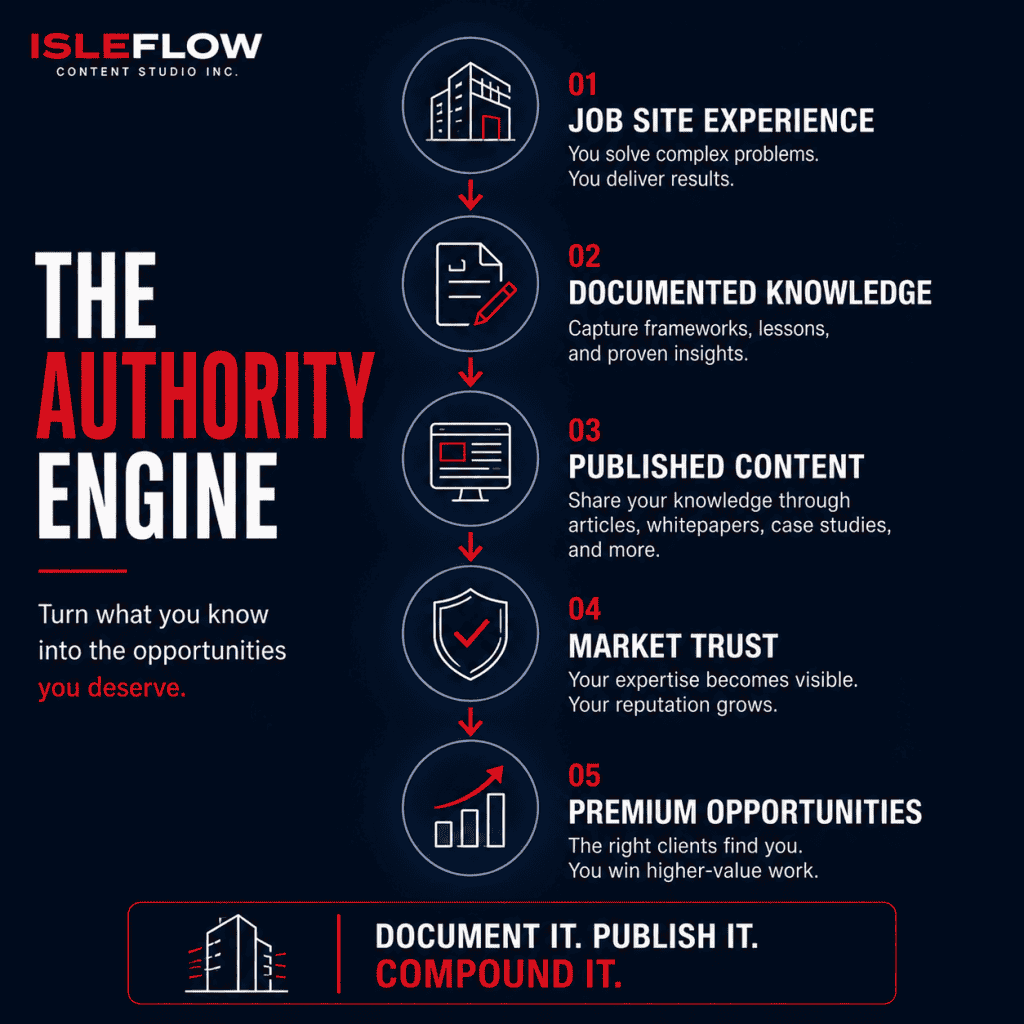
Three Steps to Turn Technical Excellence into a Bid-Winning Asset
Building the Authority Engine is not a single initiative. It is a sequence of decisions that compounds over time, with each layer of published expertise adding to the perception of authority that owners carry into the selection process. The three steps below are not a campaign. They are a system.
Name and Document Your Proprietary Processes
The starting point is identifying where your firm has genuine, defensible expertise and documenting it in a form that can travel beyond your organization. This means naming your proprietary workflows and committing them to paper.
If your preconstruction coordination process is more rigorous than industry standard, it deserves a name and a written description that can be shared with owners who would benefit from understanding it. If your approach to digital twin handover creates measurable value for facility operators, that process is a publishable framework, not just an internal operating procedure. The act of naming and documenting these workflows does two things simultaneously: it makes them transferable internally, and it makes them visible externally to clients and prospects who are looking for evidence that your firm has thought more carefully about their problems than your competitors have.
Owners can act on a two-page process overview that explains your coordination methodology, what it checks for, how it differs from standard practice, and what it has delivered on past projects. They skim a 40-page capability statement. The documented framework is a more powerful sales tool precisely because it is specific and verifiable.
Publish Technical Perspectives That Speak to Owner Problems
The second step is moving documented expertise into public-facing channels. This is where the gap between technically excellent firms and commercially visible ones becomes widest, and where the opportunity is most immediate.
Construction executives who publish regularly on the specific challenges their target clients face create a presence in their market that proposal effort alone cannot replicate. A short whitepaper on what owners consistently get wrong in their BIM execution plans and how to structure one that actually protects their investment. A LinkedIn article on how digital twins are changing facility management decisions in the healthcare sector. A contributed piece in a relevant industry publication on the ROI of preconstruction coordination on large-scale commercial projects.
These are not marketing materials. They are credentialing assets that demonstrate your firm has not only done this work but has thought about it deeply enough to teach it. That distinction matters in best-value procurement, where evaluators are actively looking for evidence of expertise, not just capability statements.
The key discipline is speaking to owner outcomes rather than technical features. The firms that publish “here is how our BIM process works” are speaking to themselves. The firms that publish “here is how to evaluate whether your contractor’s BIM process is actually protecting your project” are speaking to owners. The second approach builds authority. The first creates noise.
The Authority Capstone
The compounding effect of documented frameworks and published perspectives reaches its most powerful form in the published book. A construction executive who has documented their expertise in a published work occupies a different position in every subsequent professional conversation.
A book is not a longer whitepaper. It signals that this firm has committed to a subject deeply enough to document it in full, and that level of commitment is visible to every owner, developer, and industry peer who encounters it. A book travels in ways other assets do not. It gets referenced in industry conversations, cited in procurement discussions, and passed between colleagues in the kinds of networks that put a firm’s name in front of owners it has not yet met. For firms competing on technical authority, a published book is the single most durable credentialing asset available because it is the one no competitor can easily replicate.
The Market Is Not Short on Technical Capability
The commercial construction market heading into 2027 does not have a technology problem. Nearly every firm competing for major work has invested in BIM, VDC, and digital coordination. The firms with genuine depth have built capabilities that their clients will benefit from significantly, if those clients select them.
The problem is that capability does not determine selection. Perception determines selection, and perception is determined by what is visible, documented, and credible before the formal process begins. The technically excellent firms that understand this build their Authority Engine deliberately, one published asset at a time, until the market’s perception of their expertise matches the reality of it.
The firms that do not make this shift continue to compete on the same ground as less capable competitors, winning some bids, losing others, and never fully understanding why their results do not reflect what they know they can deliver.
Technical excellence got you to the table. The Authority Engine is what wins the seat at the head of it.
Frequently Asked Questions
What is the difference between BIM capability and BIM authority in construction?
BIM capability refers to a firm’s technical capacity to deploy digital construction tools effectively, including coordination workflows, model management, and digital twin delivery. BIM authority is the market’s perception of that capability, shaped by what is publicly visible and documented. A firm can have excellent BIM capability and very low authority if its expertise has never been published or made verifiable to owners outside the formal proposal process. Authority is what converts capability into a pre-qualification advantage.
Why do owners struggle to evaluate BIM quality in contractor proposals?
Most commercial owners, including experienced developers and institutional clients, are not equipped to assess the technical depth of competing BIM proposals. They can evaluate outputs but not methodology. As CMAA’s research on owner-centric BIM notes, owners consistently prioritize how digital tools serve their interests as asset managers over how they serve the contractor’s coordination process. When owners cannot differentiate on technical depth, they differentiate on credibility and perceived expertise, which is exactly the terrain the Authority Engine is designed to win.
How do technical whitepapers and published frameworks actually influence bid outcomes?
Published technical frameworks influence bid outcomes by shaping owner perception before the formal evaluation begins. Best-value procurement processes weight demonstrated expertise alongside price and schedule. A firm whose principals have published credible, owner-focused perspectives on the exact challenges a project presents enters the evaluation with a perception advantage that no proposal can create from scratch. The effect compounds over time as each published asset adds to the firm’s visible body of work.
How long does it take to build technical authority in a construction market?
The timeline depends on the consistency of output and the specificity of the niche. Firms that begin with a focused whitepaper or case study series targeting a specific owner segment, such as healthcare developers or municipal infrastructure owners, often see the first perception shifts within six to twelve months. Each published asset reinforces the previous ones. A published book accelerates the process significantly because it signals a level of commitment that no single article or whitepaper can match.
Related reading: our guide to construction content marketing, construction case studies that win commercial bids, and the commercial authority stack framework.
Ready to establish your authority and differentiate your construction business? At IsleFlow Content Studio Inc., we work with construction executives to publish professional books that differentiate you from competitors, command premium pricing, and create lasting industry authority. Our proven publishing process is designed for busy construction professionals who want to become published authors without disrupting their business operations.
We guarantee your satisfaction — if you’re not completely satisfied with your book, we’ll work with you until it meets your expectations.
About the author:
Robert Puharich is the founder of IsleFlow Content Studio Inc. and author of Building Brilliance. He helps construction firms build the trust, authority, and credibility that makes them the first call, not just another bid.
