
The 2026 Commercial Construction Authority Outlook

With half of 2026 behind the industry, the picture for commercial construction is clearer than it was in January. The American Institute of Architects’ Consensus Construction Forecast projected 3.0 percent growth for commercial facilities this year, with that figure expected to accelerate to 3.5 percent heading into 2027. Those numbers have largely held, but the stability has not translated into easier competition. As firms from weaker segments of the nonresidential market redirect their capacity toward commercial work, the pool of bidders on high-value contracts has deepened, and owner selection processes have grown more deliberate as a result.
Key Insights
- Commercial construction spending is tracking toward growth in 2026 and 2027, but increased competition is making the fight for high-value contracts more selective than ever.
- Technical skill and operational capability get firms to competitive parity, not create the separation that wins premium contracts.
- The Sixth Factor is the only competitive lever a construction leader controls regardless of what the market does.
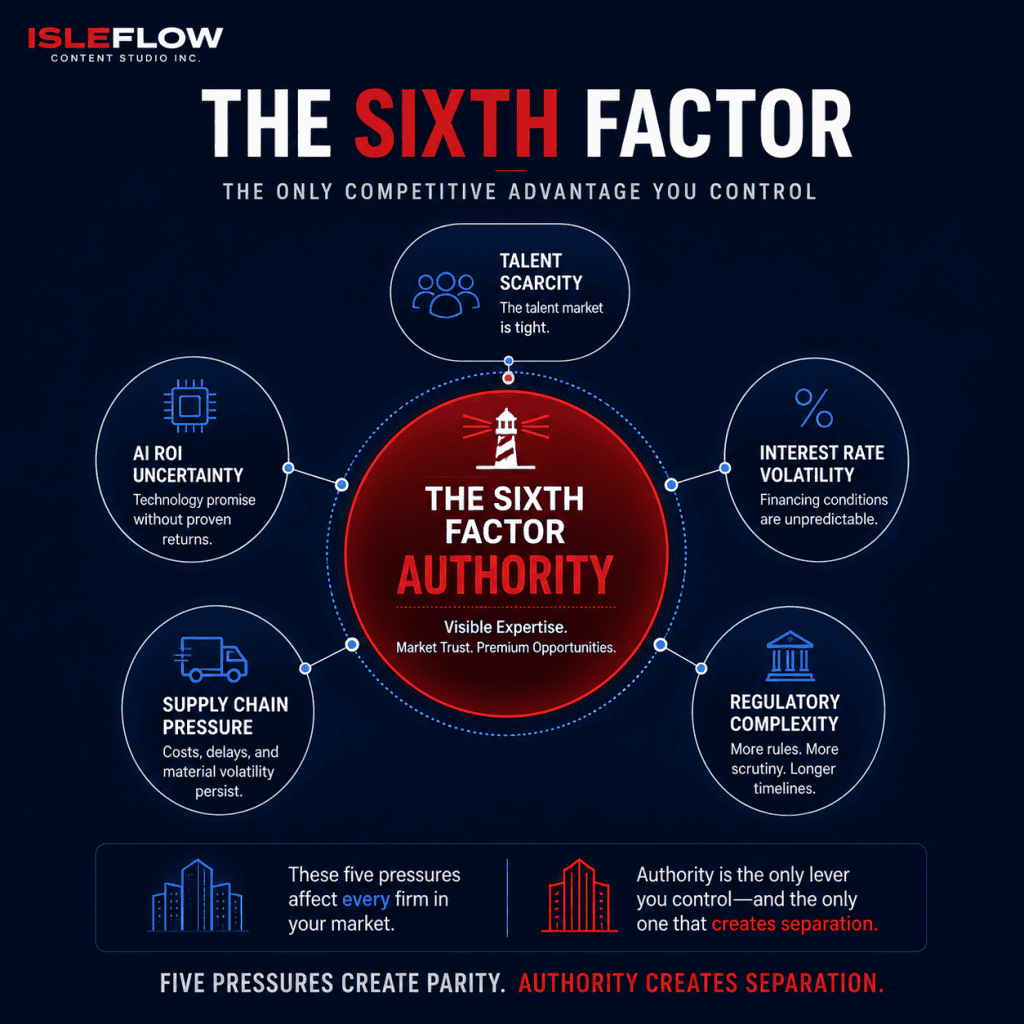
As selection processes tighten, the most valuable institutional and commercial contracts run increasingly through best-value frameworks where demonstrated expertise, track record, and market credibility carry real weight. The American Institute of Architects has characterized the broader nonresidential market as growing at just 1.0 percent this year, meaning more firms are competing for a narrower band of attractive commercial work. That shift is pressuring firms to confront structural challenges that technical capability alone cannot resolve. Most leaders in 2026 are focused on five of them. The firms pulling ahead are managing a sixth.
Those five pressures define the competitive landscape heading into 2027: talent scarcity, interest rate volatility, supply chain recalibration, the struggle to find real ROI in construction technology, and an increasingly complex regulatory environment. Each one demands attention. But they share a common limitation. Every firm in your market is fighting the same battles. Winning on those five fronts gets you to competitive parity, not competitive advantage. The Sixth Factor is what creates the separation.
The Five Market Pressures Defining the Path to 2027
The structural headwinds shaping commercial construction in 2026 are not new. What has changed is their combined weight. Each of the following pressures has existed in some form before. Together, heading into the second half of the year, they have created a competitive environment where meeting the baseline is expected and standing out requires something different.
Talent scarcity remains the most immediate constraint. The construction industry is no longer dealing with a skills gap in the traditional sense. It is dealing with a people gap. ConstructConnect reports that construction wages are rising faster than the broader economy, with annual increases exceeding 4 percent, as firms compete for a shrinking pool of experienced field labor and project management talent. Attracting and retaining that talent is increasingly tied to factors well beyond compensation.
Interest rate volatility continues to delay project decisions. While rates have moderated from their 2023-2024 peaks, they remain high enough to complicate project financing for institutional and commercial owners. Developers are taking longer to commit, and the projects that do move forward are being evaluated more carefully at the selection stage.
Supply chain recalibration is shifting cost structures across the industry. The pandemic-era scramble for materials has settled, but firms have not returned to pre-2020 procurement patterns. Tariff-driven cost increases on key inputs, including steel, aluminum, and copper, are adding uncertainty to project budgets and creating pressure on firms to demonstrate financial discipline alongside technical capability.
The promise of artificial intelligence in construction has not yet translated into clear, measurable returns for most firms. Technology adoption is widespread, but ROI remains elusive outside of a handful of specialized applications. Firms are investing in platforms and tools while their competitors do the same, without either gaining durable advantage.
Regulatory complexity rounds out the picture. Environmental mandates, zoning changes, and shifting federal funding priorities are adding scope and uncertainty to project planning, particularly in institutional and public-sector commercial work where permitting timelines have extended considerably.
Together, these five pressures consume the attention and resources of virtually every commercial firm in the market. That is precisely the problem. When every firm is managing the same challenges, competition reduces to a question of price and proposals, a pattern the industry’s most capable builders recognize as the Commodity Trap. The Sixth Factor, authority, exists outside this dynamic entirely. Rather than competing within the same constraints, it reshapes the selection conversation before the formal process begins.
Four Trends Redefining Construction Leadership
The five pressures above are market conditions. Leaders can manage them but not eliminate them. What leaders can control is how they are perceived in relation to those pressures. The four trends below are making that positioning more decisive heading into 2027, not less.
From Project Manager to Industry Voice
The most significant shift happening in commercial construction leadership is not technological. It is perceptual. Owners and developers evaluating major commercial projects are no longer just asking who can build it. They are asking who understands the problem well enough to be trusted with it.
The executives pulling ahead in 2026 have made a transition most of their competitors have not yet considered. They have moved from managing projects to managing market perception. They are writing about the challenges their clients face. They are speaking at events their clients attend. They are publishing work that documents their approach to problems their clients are already worried about. None of this replaces project delivery capability. It contextualizes it. A published perspective on commercial construction risk, labor management, or sector-specific development challenges is not just content. It is a credential that travels to rooms your firm has not yet entered.
From AI Adoption to AI Authority
Artificial intelligence is reshaping construction project management, estimating, and field operations in ways that are still unfolding. The firms winning the most attention from sophisticated owners are not necessarily the ones with the most technology. They are the ones who can articulate, clearly and credibly, how AI should be applied in their specific sector.
As Capitol Technology University noted in its 2026 construction industry review, digital transformation is becoming a baseline expectation, and demand is accelerating for professionals who can bridge construction operations with data-driven decision-making. The opportunity for forward-thinking executives is not simply to adopt these tools but to define the frameworks for using them well. A published perspective on AI implementation, covering what works, what does not, and what the risks are in a specific area of the market, positions a firm as the authority on this question for clients who have been bombarded with AI promises and are looking for someone who can make sense of them.
Leading the Green Building Mandate
Sustainability has moved from preference to requirement in a growing segment of commercial construction. LEED certification, net-zero commitments, and evolving local energy codes are now procurement criteria on institutional and municipal projects, not optional considerations. The firms that have documented their approach to navigating green building requirements, through whitepapers, case studies, and published methodology, are not just compliant. They are positioned as the authority on compliance in markets where that expertise is increasingly in demand.
The opportunity is particularly significant in sectors where owners face regulatory pressure they do not fully understand. A construction executive who has published clear, authoritative work on managing green building mandates is solving a real problem for that owner. That is a fundamentally different conversation than price and schedule.
The Talent Advantage of Visible Expertise
The talent pressure described earlier has a dimension most firms are not addressing. The most capable project managers, estimators, and field leaders in the market are not only evaluating compensation when they consider where to work. They are evaluating who they are working for.
High-performing construction professionals want to build their own credibility, and they want to do it by association with firms and leaders who are recognized in the industry. A construction executive with a visible body of published work is a more attractive employer than an equally capable leader who operates without that visibility. The authority stack does not just attract clients. It attracts the talent those clients expect to see on their projects.
Building Your 2027 Authority Roadmap
The firms that will lead their markets over the next decade are not waiting for conditions to improve before they invest in their visibility. They are building the Sixth Factor now, during a period when the competitive landscape is crowded enough that differentiation will be clearly visible by the time the market opens up.
The process is more structured than most executives expect.
The next step is turning internal processes into public-facing assets. The methodology your firm uses to manage risk on large commercial projects, the approach you take to pre-construction planning with developers, the framework you have developed for keeping complex multi-trade builds on schedule. These are the raw materials of the Commercial Authority Stack. Case study narratives, whitepapers, and detailed project retrospectives are not just marketing materials. They are the evidence base that best-value evaluators are looking for when they move past the proposal. Firms that begin with a focused whitepaper or case study series often find that the authority transfer starts before the full stack is complete. Each piece adds to the evidence base and compounds the perception shift over time.
The capstone is the published book. A construction executive who has documented their expertise in a published work occupies a different position in every subsequent professional conversation. It is not that the book is the only thing that matters. It is that the book signals a level of commitment to documented expertise that nothing else quite replicates, and the credibility it creates extends further than most executives expect before they have done it.
The market heading into 2027 is not short on capable builders. It is short on builders whose capability is visible, documented, and defensible before the RFP lands.
Frequently Asked Questions
What is the Sixth Factor in commercial construction?
The Sixth Factor is authority: the documented, publicly visible expertise that positions a construction executive and their firm above technical parity in the selection process. While most firms focus on the five structural pressures facing the market, the Sixth Factor is the only one entirely within a leader’s control. It does not depend on market conditions or competitor moves. It is built through published thought leadership, case studies, and the visible accumulation of industry credibility over time.
What are the biggest market pressures for commercial contractors heading into 2027?
The five most significant pressures shaping the commercial construction market heading into 2027 are talent scarcity, interest rate volatility, supply chain recalibration, the challenge of achieving measurable ROI from construction technology, and increasing regulatory complexity. Each demands operational attention. They are also universal. Every firm in your market is fighting them simultaneously. Managing them gets a firm to competitive parity. It does not create the separation that wins high-value work.
How does thought leadership help construction firms win bids?
Thought leadership influences bid outcomes by shaping how owners and developers perceive a firm before the formal selection process begins. Best-value procurement frameworks weight expertise and credibility alongside price and schedule. A firm whose principal has a published body of work on the specific challenges the owner faces enters the evaluation with a perception advantage that a proposal alone cannot create. The effect is most pronounced on projects where the owner is making a long-term relationship decision, not just selecting a contractor for a single build.
How do construction executives build authority in their market?
Building authority in the commercial construction market follows a three-part sequence. The first step is identifying the specific niche where a firm’s expertise is deep enough to be genuinely defensible. The second is documenting internal processes and project insights as public-facing assets, including whitepapers, case studies, and industry commentary. The third is the authority capstone, a published book that positions the executive as the definitive voice on their area of specialization. Each layer builds on the previous one, and the cumulative effect compounds over time in ways that individual marketing efforts do not.
Related reading: our guide to construction content marketing.
Ready to establish your authority and differentiate your construction business? At IsleFlow Content Studio Inc., we work with construction executives to publish professional books and content that differentiate you from competitors, command premium pricing, and create lasting industry authority. Our proven publishing process is designed for busy construction professionals who want to become published authors without disrupting their business operations.
We guarantee your satisfaction — if you’re not completely satisfied with your book, we’ll work with you until it meets your expectations.
About the author:
Robert Puharich is the founder of IsleFlow Content Studio Inc. and author of Building Brilliance. He helps construction firms build the trust, authority, and credibility that makes them the first call, not just another bid.
