
Why Skilled Contractors Lose Work to Less Experienced Firms

It happens in construction markets across North America. A contractor with superior technical skills, a longer track record, and a better safety record loses a project to a firm with half the experience. The loss is not an anomaly. It is a pattern, and the reason has nothing to do with the quality of the work. When clients cannot distinguish between qualified options through independent research, they default to whoever they already recognize. Authority determines recognition, and most skilled contractors have never deliberately built any.
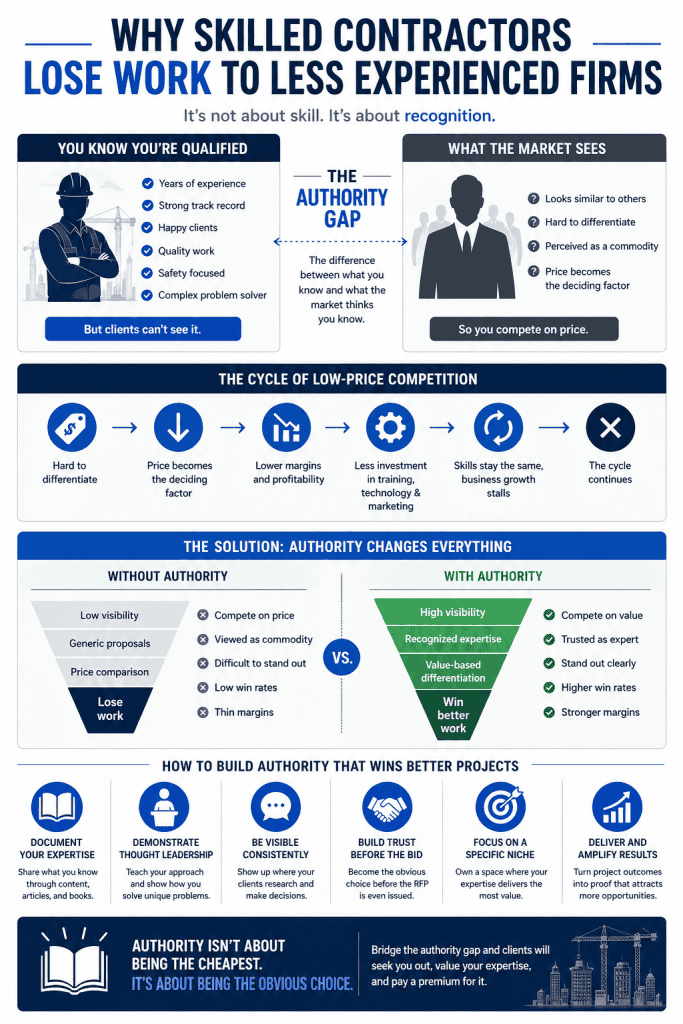
This isn’t about replacing real skills with marketing tricks. It’s about understanding how clients choose contractors today. When two companies have similar qualifications, why does one get more profitable projects while the other keeps competing on price? Often, the difference comes down to what we refer to as the authority gap.
The authority gap is the difference between what you actually know and what the market thinks you know. It’s what keeps many good contractors from getting the projects that match their skill level. Understanding this gap can help contractors make better business decisions about how they present themselves to potential clients.
Why Good Work Alone Might Not Be Enough
Every contractor knows this situation. You’ve worked hard to perfect your skills. You’ve finished tough projects, solved complex problems, and your past clients are happy with your work. Your portfolio shows you can deliver quality. But somehow, better projects often go to competitors who may not be more skilled than you.
What’s happening here? The construction industry has changed in how clients pick contractors. Having technical skills is now the starting point, not the finish line. It’s like having a driver’s license — necessary to drive, but it doesn’t make you a racecar driver. Many contractors haven’t noticed how much client expectations have shifted.
For larger projects, clients often look at more than just price, experience, and bonding. Today’s decision-makers want to see signs that a contractor thinks strategically and brings fresh ideas. They’re looking for partners who understand business goals, not just building specs.
This shift demonstrates how businesses approach value and risk differently today. Winning bids now often means demonstrating unique value beyond just price and basic qualifications. This unique value often comes from showing your expertise in ways that clients can easily understand and appreciate.
The tricky part is that these new factors aren’t usually written in RFPs. The real decisions often happen when teams discuss which contractor seems most capable of handling surprises or bringing new solutions. These discussions focus on impressions and perceptions as much as facts and figures.
When Being Good Makes You Average
Here’s what makes construction unique. Excellent technical skills have become a minimum expectation. Every qualified contractor can read plans, manage crews, and deliver projects on spec. The abilities that once set experts apart from beginners are now just entry requirements. This means being really good at construction can actually make you seem average in the market if you don’t demonstrate it in various ways.
Consider how this works in real-life situations. A mechanical contractor might know hospital systems inside and out, including infection control, pressure requirements, and special filtration. However, when bidding on healthcare projects, their proposal may resemble one from a general mechanical contractor. Why? Because clients often can’t see the difference in expertise when it’s not clearly communicated.
This visibility issue worsens over time. Without clear differences, contractors mainly compete on price, which hurts profit margins. Lower margins mean less money for training, technology, or marketing. This creates a cycle where skills stay high but business struggles.
The construction industry has always been cautious about self-promotion. Many contractors see marketing as conflicting with honest, straightforward values. However, this reluctance to be visible allows competitors who are better at communication to win more work, regardless of their actual skills.
This gap between expertise and recognition frustrates specialized contractors the most. These companies often have knowledge that could improve projects and save money. However, without ways to showcase this expertise, their valuable insights remain hidden on job sites, instead of attracting new clients.
Getting Out of Low-Price Competition
The authority gap feeds into construction’s biggest problem of competing mainly on price. When clients can’t tell contractors apart based on skills or value, price becomes the main factor. This hurts everyone. Contractors lose money, clients get basic work that just meets minimum standards, and the whole industry’s reputation suffers.
Getting out of this cycle takes more than just refusing to bid low. It requires helping clients see and value what makes you different. This isn’t about fancy marketing. It’s about making your real expertise clear to decision-makers who currently see you as just another option.
The way out is through becoming known for specific expertise. Instead of being another general contractor, successful firms become known as experts in certain project types or methods. This lets them compete in smaller groups where their knowledge commands better prices.
Consider two contractors who build retail spaces. One is known as the expert in fast retail renovations for high-end brands. Both might have the same technical skills, but the specialist attracts clients willing to pay more for less disruption and brand-appropriate work. The generalist competes with everyone; the specialist has fewer competitors.
Moving from commodity provider to recognized expert doesn’t happen overnight, but it doesn’t take forever either. With focused effort, contractors can start attracting better opportunities within months. The key is seeing authority building as a business strategy, not just marketing.
Why Certifications Don’t Stand Out Anymore
Licenses, certifications, and safety records are still important — no one questions that. But they’ve changed from advantages to basic requirements. Today, every serious contractor has proper licensing and insurance. What once set professional contractors apart now just gets you in the door.
This is similar to what’s happened in other fields. Just like college degrees became common rather than special, construction certifications lost their power to make you stand out. With more training programs available, more contractors have similar qualifications. When everyone has the same credentials, those credentials stop influencing who gets hired.
Younger clients and procurement professionals evaluate contractors differently than older ones did. They grew up researching everything online before making decisions. They look for articles, presentations, and other signs of expertise. A contractor who has written about solving moisture problems or shared detailed project lessons stands out from one who just lists “30 years of experience.”
This change in how clients evaluate contractors surprises many established companies. They built successful businesses on reputation and relationships, thinking these would always be enough. As new decision-makers replace retiring ones, personal connections can matter less than visible expertise. The market increasingly rewards those who can clearly show their capabilities.
Building Authority While Staying True to Your Values
The idea of building market authority makes many contractors uncomfortable. Self-promotion seems to conflict with the belief that good work should speak for itself. While this humility is admirable, it can limit opportunities when competitors understand that modern business needs both excellence and visibility.
The good news is that building authority in construction doesn’t mean abandoning your values or pretending to be someone else. The best authority comes from sharing real expertise in helpful ways. This means focusing on teaching rather than bragging, solving problems rather than just promoting yourself.
Real authority building starts with recognizing that your knowledge helps others beyond just your own projects. Every problem you’ve solved, every better method you’ve found, every lesson you’ve learned could help others facing similar challenges. Sharing this knowledge doesn’t hurt your competitive advantage — it shows your capabilities better than any credential.
To stay authentic while building authority, focus on contributing rather than promoting. Instead of talking about how great your company is, discuss industry challenges and solutions. Rather than listing completed projects, share what you learned from them. This approach builds authority while maintaining professionalism.
Build your authority around specialized knowledge from your years of focused work. What problems do you solve that others find difficult? What changes have you successfully handled? Which projects excite your team and show your best work? These questions point toward authentic authority based on real expertise.

Making the Shift From Contractor to Known Expert
Becoming a recognized authority takes planning and consistent effort. This isn’t about changing overnight or stopping your regular work. It’s about gradually building your market position while continuing to deliver good projects. The best authority-building fits naturally with your existing business rather than requiring separate efforts.
Start by identifying what makes your expertise special. Look past general skills to find specific knowledge that sets you apart. This might be deep understanding of certain building types, better ways to solve common problems, or experience with new methods. Find where your capabilities, market needs, and competitor gaps overlap.
Once you know your focus area, start documenting your insights regularly. Begin with detailed case studies that go beyond basic project facts to share how you made decisions and solved problems. Move on to articles about industry challenges, presentations at trade groups, and industry discussions. Eventually, consider creating comprehensive resources like a published book that firmly establishes your expertise.
The timeline varies based on where you’re starting and what resources you have, but most contractors see results within six months. Early work focuses on basics like clarifying your expertise area, creating initial content, and testing market response. Middle stages expand visibility through speaking, media coverage, and partnerships. Later stages cement your authority through major resources and ongoing thought leadership.
Throughout this process, focus on business results rather than vanity metrics. The goal isn’t fame but attracting better projects with higher margins. Success means faster sales, more negotiated work, and clients who value expertise over price. These real benefits justify the investment and create momentum to continue.
The Path Forward for Smart Contractors
The construction industry is changing. Traditional advantages keep getting weaker as technical skills become standardized and certifications become common. Meanwhile, clients expect more value from construction partnerships. In this changing landscape, contractors have choices. They can keep competing in crowded low-price markets or build the authority that attracts better opportunities.
This shift toward recognized expertise isn’t a temporary trend but a lasting change in the market. Just as medicine moved from general practice to specialties, construction is moving from general contracting to specialized expertise. Contractors who combine technical knowledge with visible authority create advantages that price-focused competitors can’t match.
For construction professionals serious about growing their business, addressing the authority gap is becoming increasingly important. The investment needed is small compared to equipment or technology costs, yet returns often exceed any operational improvement. More importantly, authority building creates advantages that grow stronger over time rather than wearing out like equipment.
The path is clear for those ready to adapt. Technical excellence stays as the foundation, but market authority becomes what sets you apart. In an industry where reputation drives success and relationships create opportunities, managing your market position isn’t optional anymore. It’s what separates contractors surviving on low-price projects from those thriving with clients who value expertise.
Frequently Asked Questions (FAQ)
Q. How is the construction authority gap different from regular marketing?
The authority gap focuses on showing real expertise rather than promotional messages. Regular marketing often talks about company capabilities and past projects. Authority building involves sharing knowledge that benefits the industry, publishing solutions to common problems, and establishing recognition for specific expertise. It attracts clients who already understand your value rather than trying to convince skeptics through ads. Think of it as teaching versus selling.
Q. How long before I see real business results from building authority?
Most contractors begin to see results within 6-12 months of applying focused effort. Early signs include more inquiries, invitations to speak at events, and better proposal success rates. Better project opportunities typically emerge after 12-18 months, as recognition builds. If you already have specialized expertise but haven’t made it visible, results come faster. A full transformation from price competitor to recognized expert typically takes 2-3 years of steady effort, although benefits build up over time.
Q. Can smaller contractors build authority against larger competitors?
Smaller contractors often have advantages in authority building. Limited resources naturally lead to specialization and deeper expertise in specific areas. Faster decision-making means quicker response to opportunities and content creation without bureaucracy. Experts can share knowledge directly, rather than through corporate filters. Many successful authority-building stories come from contractors with 10-50 employees who use their expertise and agility against larger but less focused competitors.
Q. How do you measure the return on authority-building investments?
Returns show up in both direct and indirect ways. Direct measures include higher proposal win rates, better project margins, lower marketing costs per new client, and a greater percentage of negotiated versus bid work. Indirect benefits include faster sales cycles, better employee recruitment and retention, improved vendor relationships, and higher-quality referrals. Most contractors recover their investment within 18-24 months through better margins alone, with benefits continuing to grow yearly. Track metrics like premium project percentage, average project size, and client quality, along with regular financial measures.
Related reading: our guide to construction content marketing, construction case studies that win commercial bids, the commercial authority stack framework, how to differentiate your construction firm in a bid, construction thought leadership, the four moves that put firms on the shortlist before the bid, and how a published book helps win construction bids.
Ready to establish your authority and differentiate your construction business? At IsleFlow Content Studio Inc., we work with construction executives to publish professional books that differentiate you from competitors, command premium pricing, and create lasting industry authority. Our proven publishing process is designed for busy construction professionals who want to become published authors without disrupting their business operations.
We guarantee your satisfaction. If you’re not completely satisfied with your book, we’ll work with you until it meets your expectations.
About the author:
Robert Puharich is the founder of IsleFlow Content Studio Inc. and author of Building Brilliance. He helps construction firms build the trust, authority, and credibility that makes them the first call, not just another bid.
