
Why Your Construction Marketing Doesn’t Win Contracts

Picture two commercial construction firms submitting for the same mixed-use development. Their resumes are nearly identical: similar project volume, comparable safety records, experienced crews. One firm has published six case studies on their website, bylined articles in trade publications, and their principal spoke at two industry conferences this year. The other has a project photo gallery and a LinkedIn page they update occasionally. Both firms are technically qualified. Only one gets a call.
This is the central challenge of B2B construction marketing, and it has nothing to do with how much you spend. It has to do with what compounds.
Key Insights
- Most commercial construction contracts are effectively decided before the RFP is issued, leaving firms without published content invisible during the research phase that shapes every shortlist.
- Content marketing in commercial construction functions as a business development asset, not a marketing expense, because each piece builds cumulative authority that makes the next contract easier to win.
- The firms consistently winning high-value commercial work aren’t outspending competitors on marketing; they’re out-publishing them on the right platforms.
Why “Random Acts of Marketing” Fail in Commercial Construction
Most construction firms don’t have a marketing problem. They have a consistency problem. They publish a project photo when a job completes, issue a press release when something notable happens, and post to LinkedIn when someone on the team has a spare hour. The result is a scattered trail of disconnected impressions, none of which accumulates into anything a prospective owner or developer could point to and say “these people know what they’re talking about.”
This pattern of sporadic activity with no unifying thread is what some in the B2B world call “random acts of marketing.” The name fits. It describes how the majority of construction firms approach their external presence, and it explains why most construction marketing budgets produce little measurable return.
The reason it fails isn’t effort. It’s mechanism. Traditional advertising operates on a simple exchange: spend money, get exposure, exposure disappears when spending stops. That model functions reasonably well in consumer markets where purchase cycles are short and a single impression can drive a decision. Commercial construction is the opposite environment. Sales cycles run six months to two years. Decision-making involves multiple stakeholders. Buyers conduct deep research before initiating any vendor contact at all. In this environment, an ad campaign or a single viral post contributes essentially nothing to the close.
Research from the Content Marketing Institute consistently finds that content marketing generates three times more leads than traditional outbound marketing at 62% less cost. The reason is structural. You’re building assets rather than renting impressions.
Compounding Authority is the principle that each piece of published content adds permanently to a body of work, multiplying the value of everything that came before it. Unlike a paid impression that vanishes when the budget runs out, a published article from three years ago is still working for you today. Every piece you add increases the surface area any prospective owner can find during a research process that spans months. That is the core difference between B2B construction marketing done strategically and the random acts that never accumulate.
For a closer look at how this plays out in the pre-RFP window, see Construction Content Marketing Strategy for Commercial Firms.
How B2B Construction Buyers Actually Make Decisions
The commercial construction procurement process has a visible phase and an invisible one. The visible phase is familiar: RFP issued, proposals submitted, evaluation conducted, contract awarded. Most firms manage this phase competently. The invisible phase is where the real selection happens, and most firms are almost entirely absent from it.
Before any RFP goes out, the owner’s team has typically been conducting informal research for weeks or months. They’ve asked colleagues for referrals. They’ve searched project types and firm names. They’ve looked at websites, read case studies, and assessed which firms appear to have genuine experience with the specific scope they’re planning. By the time they sit down to write the RFP, they already have a mental shortlist of three to five firms. In many cases, that list is substantially finalized before the first piece of paper moves.
This is not a niche behavior. According to Gartner’s 2025 Sales Survey, 61% of B2B buyers prefer a rep-free buying experience. They want to research on their own terms, form their own conclusions, and engage with vendors once they’ve already made significant progress toward a decision. In commercial construction, where the stakes are higher and the scrutiny is deeper, this tendency is even more pronounced.
What makes commercial construction distinctive is the number of people involved in the decision. An owner developing a $40 million mixed-use project doesn’t make procurement choices in isolation. The owner’s representative, project manager, procurement lead, and sometimes equity partners each conduct their own informal research. A firm with a strong published presence gets multiple exposure points across that committee during an evaluation process that can span months. A firm with none gets zero.
This is where Compounding Authority operates most powerfully. Your published content is working for you continuously, across every member of the buying committee, throughout a research phase that precedes any formal contact. A case study you published two years ago may be exactly what a prospect reads the week before they decide who to invite to their shortlist.
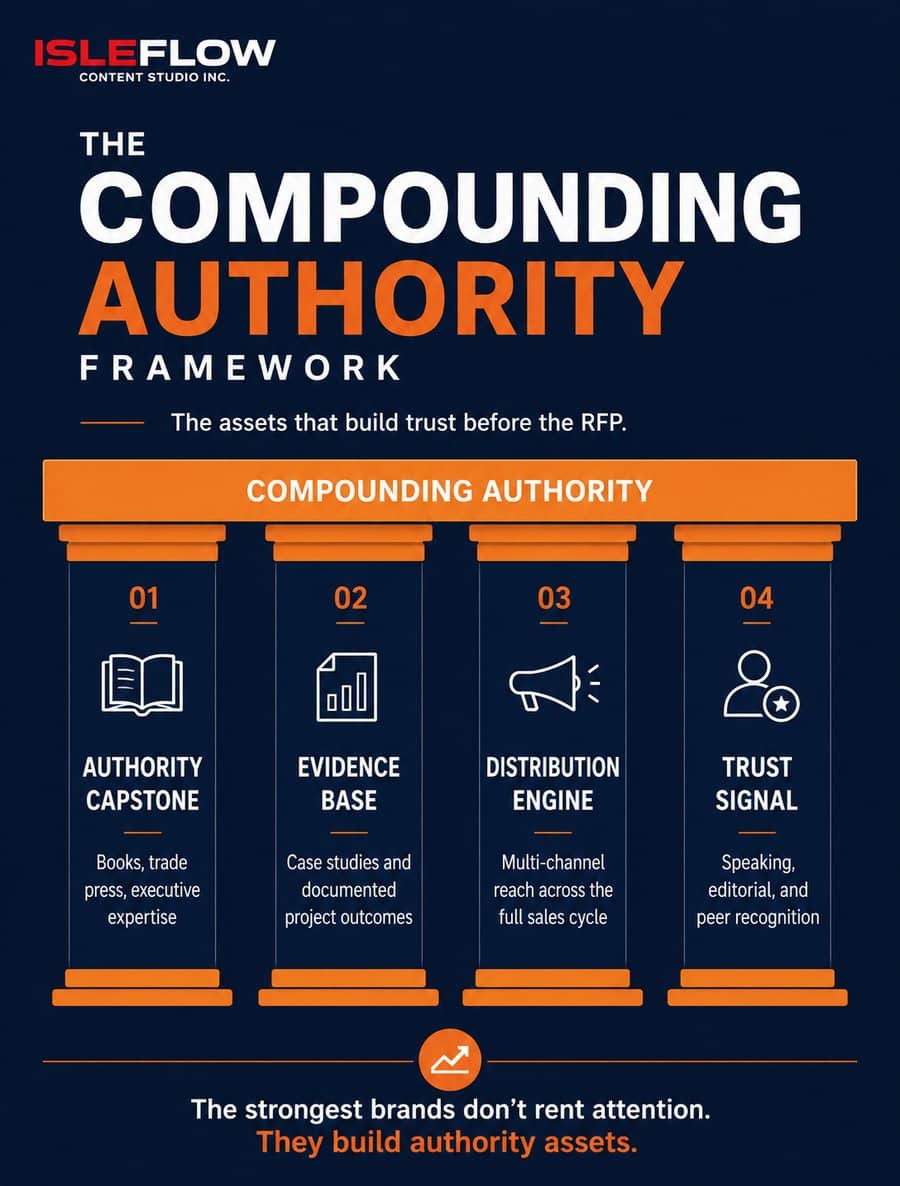
The Four Pillars of a High-Value Construction Content Strategy
If random acts of marketing are the problem, publishing strategically is the answer. In commercial construction, “strategically” means understanding what each category of content actually accomplishes and building across all four rather than defaulting to the easiest one.
Authority Capstone
The Authority Capstone is long-form content that signals executive-level expertise: bylined articles in trade publications, published research, and the most powerful format available in commercial construction, an executive-authored book. Owner organizations conducting pre-qualification research treat published authority as a proxy for capability. A principal whose thinking has appeared in Construction Executive or who has published a book on project delivery occupies a different category in the buyer’s mind than one who hasn’t. This is not a soft perception effect. It influences shortlisting decisions, often before any formal qualification process begins.
For a complete breakdown of how Authority Capstone content fits within a full content framework, see Construction Content Marketing Strategy: The Commercial Authority Stack Framework.
Evidence Base
Evidence Base is what buyers use to verify claims. Case studies, project profiles, and documented outcomes answer the question every owner’s team is asking privately: have you done this before, at this scale, with this complexity? That answer can’t live only in a proposal. By the time a proposal arrives, the buyer has usually already formed a preliminary view based on what they’ve found independently.
Effective evidence content in commercial construction goes beyond a list of project names and dollar values. Buyers want documented accounts of how your team managed scope challenges, maintained delivery schedules under pressure, and sustained owner relationships through the life of a project. That specificity is what makes case studies worth publishing. For a complete guide to writing construction case studies that influence procurement decisions, see How to Write Construction Case Studies That Win Commercial Bids.
Distribution Engine
Publishing a strong piece of content and then posting it once to LinkedIn is not a content strategy. It’s a single impression. Distribution is the mechanism that determines how many times a prospective buyer encounters your published authority during their research window, and repeated exposure is what makes content compound.
In commercial construction, distribution means putting the same substantive work in front of the same target audience through multiple channels over the course of a sales cycle. A case study gets published on the website, serialized on LinkedIn across two weeks, submitted to a trade publication for editorial consideration, and referenced in follow-up communications with prospects relevant to the project type. The case study is one asset. The distribution is what gives it reach and frequency. Most construction firms produce the asset and skip the distribution entirely. That is where Compounding Authority breaks down. Content published once is not compounding. It is sitting.
Trust Signal
Trust Signals are the external validations that establish peer-level credibility: speaking at DBIA, CURT, or SMPS events; contributing editorial to trade publications; being quoted in industry coverage. They function differently from evidence content. Evidence says “we have done this work.” A trust signal says “industry peers consider our thinking worth putting on a stage or in print.”
Owner organizations, particularly institutional owners with sophisticated procurement processes, notice these signals. They provide a form of third-party endorsement that a firm’s own content cannot manufacture. And they tend to accelerate the trust development that precedes high-value contract awards.
How to Measure the ROI of Your Construction Content
The wrong way to measure content marketing in commercial construction is to look at website traffic, social engagement, or content downloads. These are vanity metrics in a market where your total addressable audience might be 150 owner organizations in your region. If every one of them reads your latest article and none clicks a conversion button, the analytics dashboard will show almost nothing, but your business development pipeline may be quietly transforming.
According to research from Responsive, 90% of B2B buyers conduct independent research before ever speaking with a vendor, and more than half describe that research as extensive. That evaluation happens on the buyer’s timeline, through channels you cannot track, based on content you published months or years earlier. Standard analytics are not built to capture this. It is not a measurement problem that better tracking software can solve. It is a fundamental feature of long-cycle B2B buying behavior.
The right measurement framework maps content to pipeline outcomes, not platform metrics.
The first measure that matters is shortlist inclusion rate: are you being invited to more RFPs from target accounts than you were twelve months ago? Track invitations quarter over quarter against accounts where you have been actively publishing content relevant to their project types. Sustained improvement here is the signal that your content is reaching buyers during the invisible research phase.
The second is conversation quality. When prospects arrive at a first meeting, do they arrive informed about your firm’s perspective and track record? Are they asking specific questions about project types you’ve published on? That compression of the initial sales conversation, where the “who are you and what have you done” phase is abbreviated because the buyer already knows, has direct dollar value in reduced sales time and higher proposal acceptance rates.
The third is time to close. Proposals that land in front of buyers who have already been exposed to your published authority close faster and with less friction. Track average proposal-to-contract timelines against accounts where content priming occurred versus those where it didn’t.
What you won’t find in any of this is a clean attribution path from a specific article to a specific contract. That is not how Compounding Authority works. Its ROI is not measurable per post. It is measurable per year. The question isn’t “which article won us this contract.” The question is: “Are we winning better work, at better margins, with less sales friction, than we were 12 months ago?” If the answer is yes, the content is working.
Building Your Content Engine
The barrier most construction firms face is not strategy. Most leaders in this industry understand at some level that publishing builds authority and authority influences business development. The barrier is execution: who writes it, who owns it, and how it doesn’t become one person’s side project that gets deprioritized when the next phase heats up.
Getting started doesn’t require a full marketing department or a six-month content calendar. It requires picking one pillar and publishing one substantive piece this quarter. A case study from a recently completed project. A bylined article on a delivery challenge your team solved. A clear point of view, in your principal’s voice, on an issue that matters to the owners you’re trying to reach.
That one piece won’t transform your pipeline immediately. But it becomes the first layer of Compounding Authority, and every piece that follows multiplies its value. Authority builds the same way reputation does: gradually, then suddenly. The firms that treat B2B construction marketing as a compounding investment rather than a periodic expense will be on shortlists in 18 months that they didn’t know existed today. The firms that don’t will still be qualifying from behind.
Frequently Asked Questions
What is content marketing for construction companies and how is it different from traditional advertising?
Content marketing for construction companies means publishing substantive material, including case studies, executive articles, and whitepapers, that builds documented authority over time. The core difference from traditional advertising is permanence. Advertising produces impressions only while you’re paying for them. Published content continues working indefinitely. A case study from two years ago is still findable by every owner who searches your project type today. In a market where buyers conduct extensive independent research before reaching out, that permanent accumulation is what makes content marketing a business development asset rather than an expense line.
How long does it take for construction content marketing to produce measurable results?
Most construction firms see meaningful shifts in shortlist inclusion and prospect conversation quality within 9 to 12 months of consistent publishing. The qualifier is “consistent.” Sporadic publishing produces sporadic results. The compounding effect requires a body of work, which means publishing regularly over time rather than in concentrated bursts. Firms that publish intensively for three months before losing momentum are essentially back to random acts of marketing. Firms that publish one or two substantive pieces per month for a year tend to see returns that grow through year two and three.
What types of content work best for commercial construction firms targeting B2B contracts?
Case studies that document specific project complexity and delivery outcomes perform consistently well because they answer the exact questions buyers are researching during the invisible evaluation phase. Executive-authored articles and bylined trade press contributions rank highly for authority signaling. Speaking engagements at owner-attended events function as trust signals that accelerate pre-qualification. Video content has growing effectiveness for demonstrating site capability and team credibility, particularly for project types where visual proof matters. The specific combination depends on the owner organizations you’re targeting and the project types you want to win. But the underlying principle holds across every format: specificity outperforms generality every time.
How should a construction firm measure the ROI of its content marketing?
Track three metrics against your target account list: shortlist inclusion rate, proposal conversion rate, and average time to close. Shortlist inclusion rate answers whether you’re being invited to more RFPs from named accounts. Proposal conversion rate answers whether you’re winning a higher percentage of the proposals you submit. Time to close answers whether proposals are progressing faster. Supplement this with qualitative tracking of first-meeting quality. When prospects arrive already informed about your work without you telling them, that is the content working. Do not rely on web traffic or social engagement as primary indicators. In a B2B construction market with a small, defined audience, those numbers will remain modest even when the content is performing well.
The most powerful Authority Capstone a construction executive can build is a published book. If you’re ready to turn your expertise into the content asset that wins you the room before the RFP, learn how IsleFlow helps construction executives publish their book.
We guarantee your satisfaction — if you’re not completely satisfied with your book, we’ll work with you until it meets your expectations.
About the author:
Robert Puharich is the founder of IsleFlow Content Studio Inc. and author of Building Brilliance. He helps construction firms build the trust, authority, and credibility that makes them the first call, not just another bid.
