
The Four Moves That Put Commercial Construction Firms on the Shortlist Before the Bid

Most construction firms know their content marketing is inconsistent. Fewer have a clear system for fixing it. This guide provides that system. The four moves covered here are not a general content approach. They are the specific, sequenced actions that translate technical expertise into documented authority. Each move creates a tangible output. Those outputs compound, and the firms that complete all four arrive at a position their competitors cannot easily replicate. They are already on the shortlist before the RFP is drafted.
Key Insights
- The construction firms found during a commercial buyer’s pre-RFP research are the ones that documented their expertise before the search began.
- A Proprietary Process Document, a case study library, a published executive book, and a consistent LinkedIn presence form one compounding authority system, not four separate marketing tasks.
- The firms winning best-value bid invitations are not the ones with the biggest marketing budgets but the ones with the most documented expertise.
What Commercial Buyers Do Before They Issue the RFP
Commercial buyers in the construction sector do not begin shortlisting when the RFP goes out. They build a working list in the weeks and months before that, often before a formal project budget has been approved. By the time a bid package is drafted, the firms being considered have already demonstrated their expertise somewhere the buyer could find it independently.
According to Gartner’s B2B Buying Journey research, B2B buyers use an average of seven information sources during a purchase decision. In commercial construction, those sources include LinkedIn profiles, published articles, industry bylines, case study libraries, and executive books. A firm that exists across multiple formats has a presence advantage before the first phone call. A firm that exists in none of them is invisible at the moment that matters most.
The tactical implication is direct. The research window opens well before the bid window. Content that reaches a buyer during the research phase does not register as marketing. It registers as evidence of capability. The firms that show up during this phase are the firms that get called when the project is ready.
The most common mistake construction firms make is producing content after they hear about a specific project, hoping to demonstrate relevance before the deadline. That approach rarely works. By the time the bid is issued, the buyer has already formed a preliminary list. Documented authority needs to exist before the buyer starts looking.
The Authority Gap Analysis
Before building any of the four moves, a firm needs an honest assessment of where it currently stands. That assessment comes down to four questions. Does the firm have a documented point of view on its specific project type and the problems that come with it? Does it have case studies that go beyond project photos to show a specific challenge, how it was solved, and what the measurable outcome was? Does it have a published authority credential that a buyer could find and verify independently? And is it producing content consistently enough to remain visible between bid cycles?
A firm that cannot answer yes to all four has an authority gap. As covered in Why Your Construction Marketing Doesn’t Win Contracts, random acts of marketing fail because they do not build that kind of documented presence. The Commercial Authority Stack provides the structural model for closing the gap. The four moves in the next section are the steps that do it.
The assessment matters because it shows where to begin. Some firms already have case study material but have never formatted it as structured narratives. Others have a clear niche but have never documented it in a form that travels without them. The moves below work in any sequence, but each one accelerates the others, and a firm that completes all four holds a documented authority position that keeps working between projects.
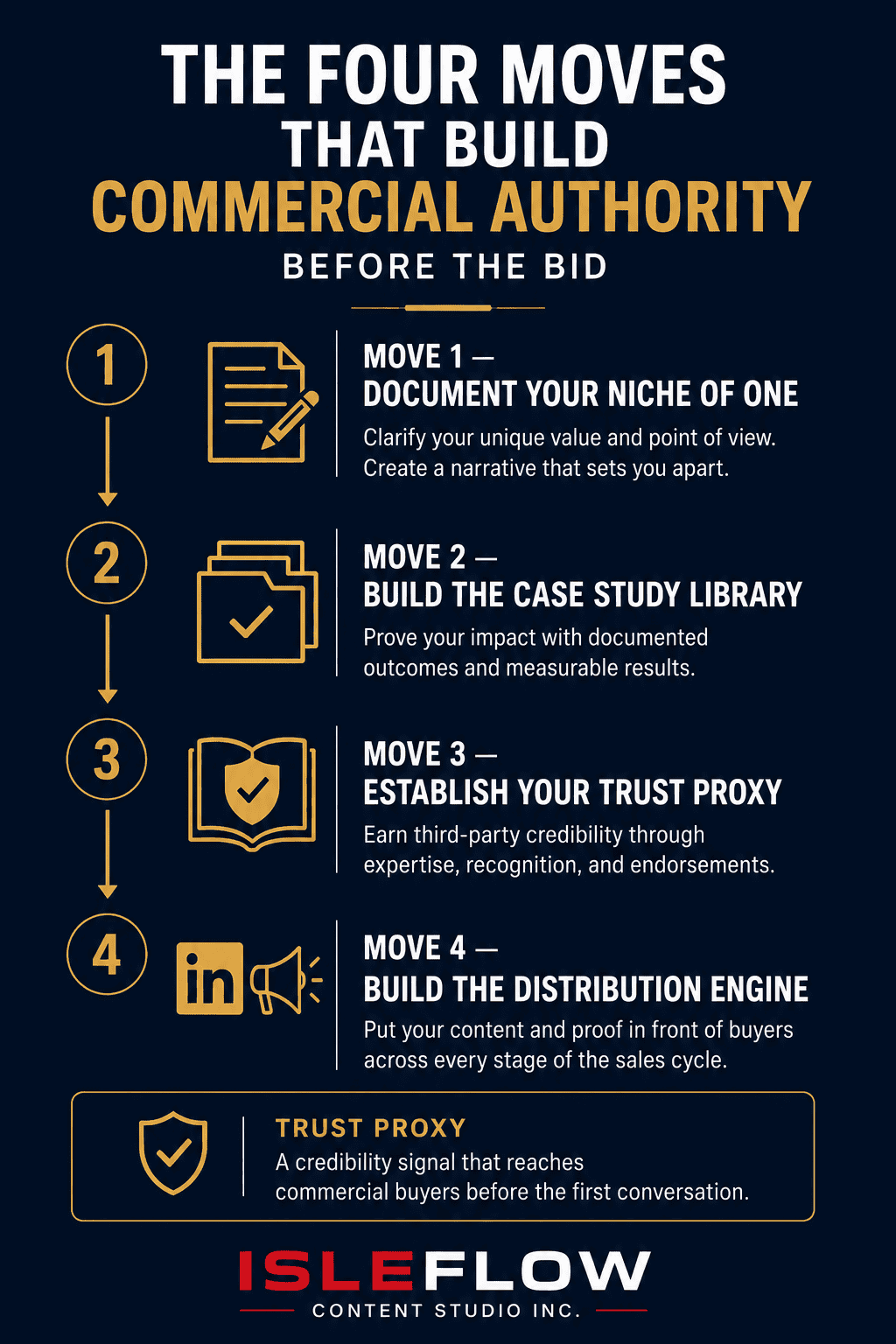
The Four Moves That Activate Your Commercial Authority Stack
These four moves do not need to be executed in a fixed sequence. Most firms can begin wherever their existing assets are strongest. Move 1 is recommended as the starting point because it defines the foundation that makes everything else coherent.
Move 1. Document Your Niche of One
The first move is identifying the specific combination of project type and problem set where a firm has a verifiable, unmatched track record. Then writing it down in a form that other people can understand without being in the room.
This output is called a Proprietary Process Document. It is not a brochure and it is not a capabilities statement. It is a one-to-two page document that names the firm’s niche, describes its specific methodology for that project type, and articulates what makes its approach distinct from a competitor with a similar portfolio. The primary audience is the firm’s own business development team. It gets shared selectively with prospects who have already indicated interest.
A Proprietary Process Document answers the question every commercial buyer is actually asking before they write the shortlist. What makes this firm specifically qualified for this type of project? Most firms cannot answer that question clearly in writing. The ones that can have already separated themselves before the conversation begins.
Everything else in the system draws from this document. Case studies, whitepaper topics, the book premise, and LinkedIn content all become coherent rather than scattered once the niche is defined on paper.
Move 2. Build the Evidence Base
Most construction firms have portfolios. Project photos, scope-of-work summaries, a list of notable completions. Commercial buyers look at those portfolios and see activity. What they need to see is proof.
Proof takes the form of a Problem-Solution-Impact narrative. Each narrative covers the specific challenge on a project, the firm’s approach to solving it, and the measurable outcome for the client. The challenge might be technical, logistical, schedule-related, or tied to a budget constraint. What matters is that it names something real. Three narratives built this way outperform a portfolio of thirty project photos for any buyer who is evaluating rather than browsing.
How to Write Construction Case Studies That Win Commercial Bids covers the full methodology for building a case study library that functions as evidence rather than a portfolio. The critical shift is from showing what was built to documenting the problem that was solved and how. The first is a portfolio entry. The second is something a buyer can use internally to justify recommending the firm.
Move 3. Install the Authority Capstone
Of all the authority credentials a construction firm can build, a published book is the strongest Trust Proxy available to it. A Trust Proxy is a verifiable, permanent credential that signals deep expertise to commercial buyers who have no prior relationship with the firm. The Proprietary Process Document is a light Trust Proxy. A strong case study library is a stronger one. A published book is the strongest because it is the most verifiable, the most permanent, and the hardest to replicate.
A buyer can verify a book in thirty seconds. It is attributed, searchable, and it signals a career’s worth of thinking rather than a single project outcome. When a buyer encounters a book written by a principal at a firm they are evaluating, the question of whether that person knows the subject is no longer on the table.
The Edelman-LinkedIn B2B Thought Leadership Impact Report found that 75% of executives explored products or services they were not previously considering after engaging with compelling thought leadership. A book is the highest-leverage thought leadership format in that dynamic because it stays in circulation indefinitely. An article gets read once. A book gets referenced, gifted, and found in a search years after it was published.
IsleFlow works with construction executives to develop their expertise and accumulated knowledge into a finished manuscript. The executive’s voice, methodology, and industry-specific insights stay at the center of the work throughout.
Move 4. Build the Distribution Engine
The first three moves create documented authority. The fourth circulates it.
LinkedIn is where commercial construction decisions get quietly influenced. An owner’s project executive reads a post from a firm’s principal about a challenge in a specific project type. The post does not look like marketing. It reads like the perspective of someone who has dealt with that problem before. Six months later, when that project executive is building a preliminary shortlist, the name is already there.
Native authority on LinkedIn means content produced directly on the platform, not links to articles elsewhere. LinkedIn’s algorithm rewards posts that keep users on-platform. Short, specific observations about real challenges in a firm’s niche consistently outperform promotional content and link-sharing.
A sustainable weekly cadence looks like this:
- Monday: a short perspective on a challenge specific to the firm’s project niche, drawn from a current or recent experience
- Wednesday: a single finding or outcome from a published case study, stated in two to three sentences
- Friday: an observation about the direction the firm’s specialty is heading, stated as a position or an open question
One technical whitepaper generates ten LinkedIn posts. Each section heading becomes a post hook. Each key finding stands alone as a single post. A quoted client result becomes a Wednesday entry. The content already exists in the system. The cadence makes it visible to the right people.
The goal is not follower counts. It is to appear in the feed of the people on an owner’s shortlisting committee when they search the firm’s name. One post read at the right moment by the right person does more for a bid than ten thousand impressions from the wrong audience. A consistent LinkedIn presence is itself a Trust Proxy. It signals to buyers that the firm’s expertise is current and active, not archived in a credentials deck that was last updated three years ago.
Three Signals That Show Your Authority Approach Is Working
Standard marketing metrics measure the wrong things for this kind of work. Clicks, impressions, follower growth, and open rates tell a firm how many people encountered its content. They say nothing about whether the people who matter found it at the moment that mattered.
Research from the Content Marketing Institute found that B2B organizations publishing original research report 64% higher conversion rates than those that do not. For construction firms, the equivalent is documented expertise: structured case studies, a published book, a consistent point of view on LinkedIn. The signal that this approach is working is not traffic. It is behavior.
The first signal is invitation quality. When a firm begins receiving calls about best-value bids rather than lowest-price tenders, its documented authority is reaching the right buyers. The buyers who call already know what the firm does. They are evaluating fit, not capability. The sales conversation starts in a different position because the buyer arrived informed.
The second is content referenced in the first meeting. A buyer who mentions reading the firm’s piece on a specific project type, or that a colleague brought up the firm’s book, walked in already influenced. The Trust Proxy reached them before the conversation started. This is the clearest individual signal that documented authority is working.
The third is a shorter sales cycle on high-value contracts. Construction firms with documented authority close faster on larger projects because they are not rebuilding credibility from scratch in every meeting. The buyer came in already persuaded on the core question of expertise. What remains is fit, terms, and timing.
These signals develop over time. A single strong Trust Proxy, a published book or a well-built case study, can influence a specific bid the moment it exists. The broader pattern, where a firm begins receiving calls rather than initiating them, typically takes six to twelve months of consistent execution across all four moves. The right question is not how many people saw the content. The right question is whether the right buyers found it before they finalized their shortlist.
Your Authority Roadmap Starts With One Document
The four moves do not require a full rebuild before anything becomes visible. Most firms can begin with Move 1 tomorrow. One focused session spent writing down the firm’s Niche of One, in specific terms rather than marketing language, is enough to start.
That document changes what comes after it. Case studies become easier to scope because the niche is defined. A book premise becomes clear because the methodology is on paper. LinkedIn content becomes consistent because there is a point of view to draw from. Each move accelerates the ones beside it, and the compounding effect starts from the first Trust Proxy, not the fourth.
The firms that begin building documented authority today are not just approaching their marketing differently. They are creating an advantage that compounds while their competitors are still debating whether content is worth the effort.
Frequently Asked Questions
What is content marketing for commercial construction?
Content marketing for commercial construction is the practice of creating documented proof of expertise in formats that commercial buyers find during their pre-RFP research. That includes structured case studies, published thought leadership, and consistent platform content. Unlike advertising, which stops generating results when payment stops, documented authority compounds over time. Each case study and each published piece adds to a body of evidence that buyers encounter independently when they are researching firms in a specific project niche.
How is this approach different from traditional construction marketing?
Traditional construction marketing focuses on visibility: ads, trade show presence, sponsorships, and website traffic. Those tactics generate awareness while funded and go quiet when they are not. A documented authority approach builds assets that stay active after they are created. A published case study keeps working years after it is written. A book keeps representing the firm long after launch. A consistent post history on LinkedIn keeps surfacing in searches long after the posts were published. The advantage compounds. The ad spend does not.
What is the most important first step for a firm with no existing content?
The most important first step is the Proprietary Process Document. Before producing case studies, writing whitepapers, or commissioning a book, a firm needs a written answer to one question. What is this firm specifically qualified to do, and what makes its approach distinct from a competitor with a similar portfolio? That document takes a few hours to draft and becomes the foundation for everything that follows. Nothing downstream in the authority system is wasted when the Proprietary Process Document is clear.
How long does it take for documented authority to influence bid invitations?
A single Trust Proxy can influence a specific bid the moment it exists. A buyer who encounters a published book or a well-structured case study during their research is already influenced before the first conversation. The broader compounding effect, where a firm begins receiving calls rather than initiating them, typically develops over six to twelve months of consistent execution across all four moves. The timeline is not determined by how much content a firm produces but by how visible its documented expertise is in the places commercial buyers look when they are researching a project.
IsleFlow Content Studio works with construction executives to build each level of the Commercial Authority Stack, from the initial Proprietary Process Document through to a published executive book. The firms that start today are putting distance between themselves and the competition while that competition is still deciding whether to begin.
About the author:
Robert Puharich is the founder of IsleFlow Content Studio Inc. and author of Building Brilliance. He helps construction firms build the trust, authority, and credibility that makes them the first call, not just another bid.

Related reading: our guide to construction content marketing, construction thought leadership, how to differentiate your construction firm in a bid, why skilled contractors lose work to less experienced firms, and how a published book helps win construction bids.