
Construction Content Marketing: What Wins Contracts in 2026

Construction companies investing in content marketing often see the wrong results. Website traffic from people who will never hire them. Social media engagement that does not connect to contract opportunities.
Articles that demonstrate effort without building authority. The problem is rarely effort. It is direction.
Here is the uncomfortable reality underneath it. Commercial construction firms that lose high-value contracts rarely lose them on the bid itself. The decision has already been made before the proposal lands, formed during the months or years that project owners spend evaluating their options independently, before any RFP is issued.
Content that attracts the right decision-makers during that window looks fundamentally different from content designed for visibility alone. This guide is about the difference between the two, and how to tell which one your current program is built on.
Key Insights
- Commercial buying committees form an informal shortlist through independent research before any RFP is issued, and content marketing’s real job is to put your firm on it.
- Construction procurement is a committee decision, and your content must give the owner, the procurement director, and the design team each something substantive to find.
- Three quarters of B2B buyers prefer a rep-free buying experience, according to Gartner, which means your published content is doing the selling before you ever get a meeting.
- Problem-solving content outperforms service marketing in both search visibility and buyer trust, and the gap widens as AI search rewards demonstrated expertise.
- The metrics that matter are authority metrics such as inbound RFP quality, trade media mentions, and speaking invitations rather than page views.
What Is the Invisible Shortlist?
The Invisible Shortlist is the informal ranking of construction firms that a buying committee develops through its own research before any formal procurement process begins. It is not a document. It is the accumulated product of impressions formed through published content, professional reputation, peer referrals, and whatever buyers encounter when they search for firms operating in a relevant project category.
In commercial construction, major project evaluations begin well before any formal solicitation is issued. Buyers search for firms, read published content, and consult their networks during an extended window that procurement teams rarely make visible to the contractors being assessed. The formal process typically begins with a Request for Qualifications, through which project owners create a shortlist of three to five firms before an RFP ever goes out.
What determines who receives that invitation is not the proposal that follows. It is the reputation and visibility those firms built in the months or years before procurement formally opened.
By the time an RFQ is issued, the firms on the Invisible Shortlist are the firms the committee intends to evaluate seriously. The rest are reviewed to satisfy procurement procedure.
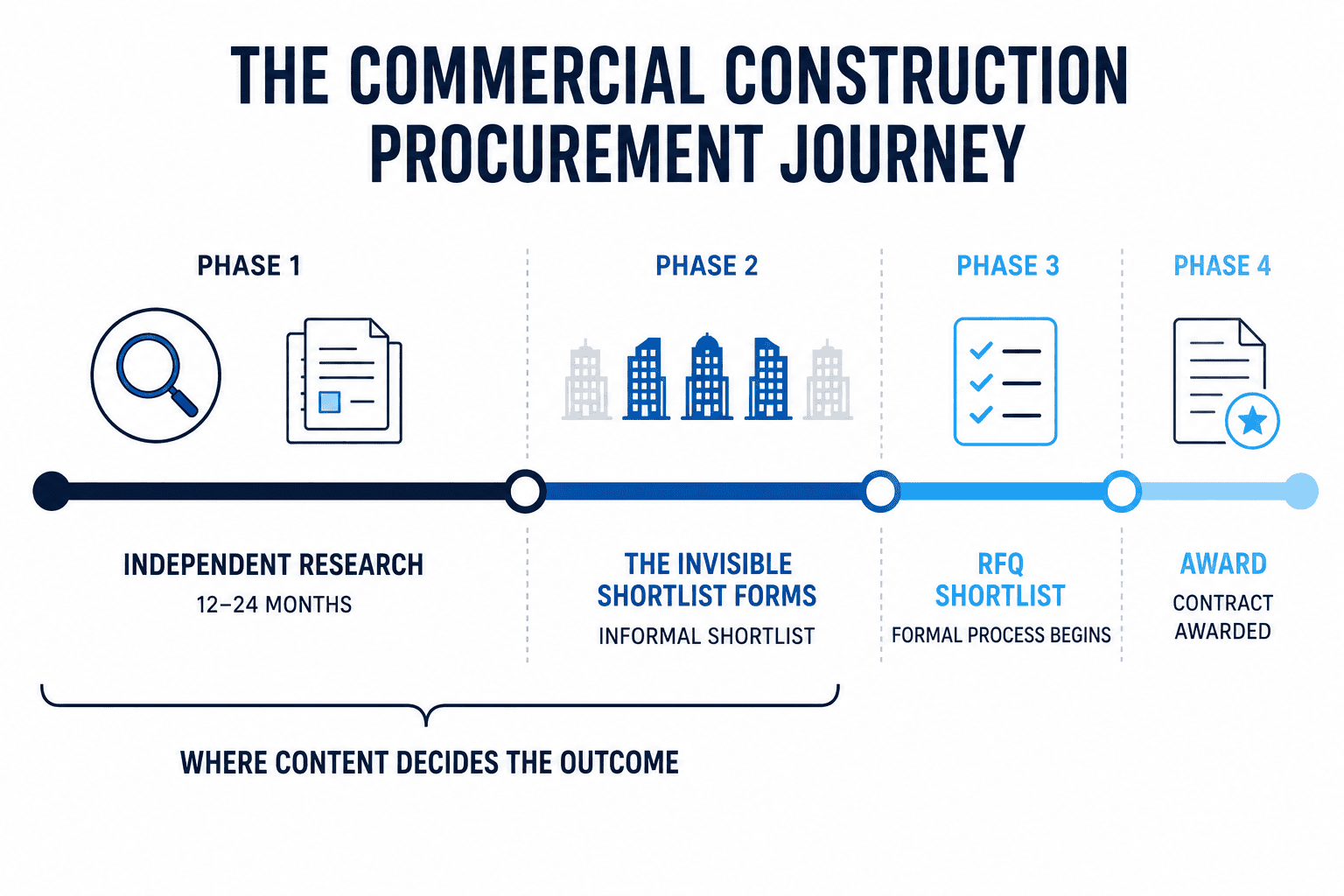
This is the phase most construction content strategies ignore. The instinct is to focus activity around the proposal stage. Websites get updated before a major pursuit, capabilities decks get revised, and a case study gets pulled from the archive and polished.
All of that activity is directed at a moment that, from a credibility standpoint, has already passed. A content strategy that works is designed to influence the Invisible Shortlist during the research phase, not to compete harder once the shortlist has already been determined.
Who Actually Decides Which Contractor Wins?
Major commercial contracts are decided by a committee, not an individual, and each member researches you against different criteria.
Developers and project owners are evaluating financial stability, documented schedule performance, and evidence of comparable project outcomes. They want proof that a firm has navigated challenges similar to the ones their project will involve, at a level of specificity beyond a project name and a completion date. A project profile that records a building name and its square footage tells a developer nothing they could not find in a press release.
Procurement directors are evaluating your demonstrated ability to manage contractual complexity, sustain performance across multiple projects, and operate within the compliance frameworks their project type requires. Their research is methodical. They are assessing operational maturity, and they are looking for published evidence that distinguishes your approach from the capability statements every competitor produces.
Architects and engineers are assessing technical depth in the specific project category their design involves. A firm publishing substantive content on healthcare construction phasing, mass timber systems, or data center infrastructure is differentiated in the eyes of a design professional comparing dozens of contractor submissions.
Generic content about construction capabilities is invisible to this audience. Specific technical content is not.
The research behavior behind all of this is well documented. Gartner’s research on the B2B buying journey finds that 75 percent of B2B buyers prefer a rep-free sales experience, doing their evaluation through websites, social media, and online search before any supplier conversation.
A content strategy that addresses only one committee perspective leaves the others with nothing specific to find. The firms that appear on shortlists consistently are the firms whose published content has given every committee member something substantive to engage with before formal procurement begins.
Content That Wins vs. Content That Gets Traffic
The most common mistake construction firms make is trying to market everything they do to everyone who might hire them. That produces content that feels generic, performs poorly in search, and fails to move procurement professionals who have seen the same claims on a hundred contractor websites. Three shifts separate content that builds shortlist position from content that builds traffic reports.
Target problem-solving keywords, not service keywords. Generic terms like “commercial general contractor” draw a broad audience that is nowhere near a contract decision. Terms like “how to manage schedule risk on phased commercial construction” or “selecting a contractor for occupied facility renovations” attract buyers who are actively researching their options.
Content that answers the questions they are already asking positions your firm as the resource they find before the conversation begins. That is a fundamentally different position to negotiate from than responding cold to an RFP.
Build content pillars around your strongest expertise. Content pillars are the three to five areas of genuine, proven expertise that organize everything you publish. If your track record is in mass timber, occupied facility renovations, or healthcare construction, those are your pillars, and every article, case study, and video should connect back to at least one of them.
Pillar-based publishing signals depth rather than breadth to risk-averse buyers. It also builds the topical authority that search engines and AI platforms use to decide which sources deserve to rank for specialized queries.
Demonstrate expertise, don’t announce it. The content that moves committees helps their members avoid costly mistakes, such as navigating building codes for a specialized facility type, managing procurement risk in volatile materials markets, or structuring contracts for multi-phase developments. Content at that level of specificity cannot be produced by a competitor without comparable project experience, which is exactly what makes it an authority signal rather than a marketing document.
Which Content Formats Carry a Commercial Sales Cycle?
Four formats carry a commercial evaluation, and no single one carries it alone. The Commercial Authority Stack is the framework we developed to organize them into a progression, each answering a distinct question a buying committee brings to its research.
The Proof Layer, built from case studies, answers the first question a committee asks. Can you actually do this?
The persuasive ones are specific about complication and recovery, not just successful delivery. Not “we completed a 200,000 square foot office tower on schedule,” but how your team managed a 14-week steel supply disruption mid-project and still delivered within the original occupancy window.
The Expertise Layer, built from whitepapers and technical guides, answers the second. Do you understand my problem deeply enough to solve it? A whitepaper demonstrating genuine expertise in a specialized area can carry more weight in an evaluation than a dozen capability statements in a proposal.
The Trust Layer, built from executive video, answers the third. Do I trust the people behind this firm? A 90-second video of your CEO explaining how your firm approaches schedule risk on occupied facilities will outperform a brand reel every time, because it speaks to the concern already in the viewer’s mind.
The Authority Layer, a published book, answers the final question before a shortlist forms. Is this firm the one? A book establishes its author as the recognized expert on a subject in a way no shorter format can replicate, and unlike a project reference, its authority does not expire with a project cycle.
Each layer makes the next more persuasive. For the full treatment of how the layers are built and compound, see the Commercial Authority Stack framework guide.
How Does a Busy Firm Actually Execute This?
Strategy fails at the execution stage more often than the design stage, and construction leaders face real constraints. Project demands, thin marketing teams, and expertise that lives in the heads of people who bill their time to jobs.
Write for search engines and AI systems at once. Search behavior is shifting from keyword queries to conversational questions, and AI platforms now answer many of them directly. Both reward clear, direct answers to specific questions, structured so the information is scannable, in comprehensive resources rather than thin posts.
This compounds the pillar strategy, because AI systems cite sources that demonstrate depth on a topic, not sources that mention it. Our guide to AI search optimization for construction covers this in detail. (For firms whose work is geographically concentrated, local SEO remains a separate, complementary discipline.)
Document projects as you build. Your work creates tangible transformations, and the raw material for case studies is captured on site or lost.
Progress photography, the complications and recoveries worth writing about, and the metrics that prove the outcome. The firms with persuasive Proof Layers collect all of it systematically rather than reconstructing it at proposal time.
Choose consistency over frequency. Regular publication builds audience expectations and search authority more effectively than sporadic bursts. An ambitious schedule that collapses after six weeks is worth less than a modest one sustained for a year.
Batching production, where several pieces are developed in a dedicated session and scheduled out, is how firms without a marketing department maintain the cadence. A construction content writer who understands procurement can carry the production load while your team supplies the expertise.
Where Should the Content Go Once It Exists?
Content that exists only on your website reaches buyers who are already evaluating you. Influencing the Invisible Shortlist requires distribution through the channels where committee members conduct their research.
LinkedIn is the highest-value channel for commercial work, because developers, owners, procurement directors, and design consultants are active there and engage with substantive content from firms they are watching. What works is consistent expert commentary, not company announcements.
Share a specific lesson from a recent project or a considered perspective on a market condition. Two or three posts a week with genuine insight will outperform daily generic content.
Sales enablement is the least-used function of construction content. A case study matching a prospect’s project type, sent at the shortlisting stage, can be more persuasive than any presentation.
A chapter from a published book, shared after a discovery meeting, keeps your firm present through the evaluation without any additional selling. Map your content backwards from the RFP by identifying what committee members are asking at each stage and matching assets to those questions.
Email sustains visibility across a cycle that may run one to three years. A well-curated quarterly digest your contacts actually read delivers more than a weekly newsletter they filter to a folder.
How Do You Know It Is Working?
Traffic metrics measure visibility. They do not measure procurement influence, and in commercial construction, revenue lags a working content strategy by one to three years, so you need the leading indicators.
The signals that a program is influencing the Invisible Shortlist are qualitative before they are quantifiable. Watch for inbound inquiries that reference specific published content as the reason for reaching out, procurement conversations that begin from an informed position rather than a cold introduction, and shortlist invitations from organizations with no prior relationship.
Alongside them, track inbound RFP quality (are the firms requesting proposals a closer match to your ideal client than before?), average contract value (authority positioning attracts buyers choosing on expertise rather than price), and the authority indicators that precede contract wins by six to eighteen months, such as trade media mentions, speaking invitations, and inbound connection requests from target contacts.
Referrals remain the dominant source of new business in commercial construction. Published authority amplifies them. When a past client recommends your firm to a developer, “look up their published work on this” is a meaningfully different introduction than “they did good work for us.”
The Shortlist Is Being Written Right Now
Somewhere in your market, a buying committee is researching firms for a project you have not heard about yet. The firms they find publishing substantive, specific work are quietly earning a place on the shortlist that will govern which proposals get read seriously eighteen months from now. The firms they cannot find were never in the competition at all.
That is the real function of construction content marketing. Not traffic, and not visibility for its own sake, but a documented body of expertise sitting in the path of buyers who are deciding who to trust before anyone knows a decision is being made. The firms that win are rarely the ones publishing the most; they are the ones publishing for the window that decides.
Frequently Asked Questions (FAQ)
What is content marketing for commercial construction, and how does it differ from regular marketing?
Content marketing for commercial construction builds credibility with project owners, developers, and procurement teams through published educational content rather than direct advertising. The core difference is timing. Traditional marketing reaches buyers when you want them to see your message, while content marketing builds credibility before buyers are actively evaluating, so your firm is already on the shortlist when the opportunity emerges.
How long does construction content marketing take to produce results?
Results typically become measurable within six to twelve months and reach full impact over two to three years, reflecting the length of commercial sales cycles rather than a weakness in the strategy. Leading indicators generally emerge within the first six months, including inbound traffic, LinkedIn engagement from target contacts, and trade media mentions.
What types of content work best for winning commercial construction contracts?
Case studies, technical whitepapers, executive video, and published books deliver the strongest results, in combination. Case studies prove performance in comparable situations, whitepapers demonstrate technical depth, video builds trust before direct contact, and a published book establishes recognized authority in a way no shorter format can replicate.
How early before an RFP should a firm start building content authority?
The Invisible Shortlist forms continuously, not in response to any procurement event. A firm beginning consistent content development now is building position for the procurement cycles opening eighteen to twenty-four months out. Firms that begin after a major RFP is announced are competing at the proposal stage rather than the research stage, which is a significantly weaker position.
Can a mid-size construction firm compete with larger firms through content marketing?
Content marketing is a meaningful equalizer. A national brand’s scale is hard to match in marketing spend, but thought leadership is not determined by company size. A regional contractor publishing consistently on a specific niche (healthcare construction, urban infill, mass timber) can build more credibility in that niche than a larger generalist that publishes nothing.
How do you create content for a construction company?
Start with the questions your buyers are actually researching, not a description of your services. The highest-performing construction content is specific: case studies that document real project outcomes, technical guides on the challenges your clients face, and executive commentary published where procurement teams look. Consistency matters more than volume. One focused piece each week on your strongest project category builds more authority than sporadic general posts, and a construction content writer who understands procurement can carry the production load while your team supplies the expertise.
Ready to establish your authority and differentiate your construction business? At IsleFlow Content Studio Inc., we work with construction executives to develop the content assets that influence buying committee evaluations before a solicitation is issued, from documented case studies through to professionally published books. Our process is designed for busy construction professionals who want to build lasting authority without disrupting their business operations.
We guarantee your satisfaction. If you are not completely satisfied, we will work with you until it meets your expectations.
About the author:
Robert Puharich is the founder of IsleFlow Content Studio Inc. and author of Building Brilliance. He helps construction firms build the trust, authority, and credibility that makes them the first call, not just another bid.
