
The AI Marketing Advantage Only 1.4% of Contractors Are Using

The AI Marketing Advantage Only 1.4% of Contractors Are Using
Table of Contents
AI-powered search has changed how project owners, developers, and procurement teams find and evaluate construction firms. The contractors appearing in AI-generated answers to buyer research questions are building familiarity at a stage that did not exist two years ago, before any direct contact, before an RFP, before a referral is made. Only 1.4 percent of construction companies are currently optimizing for this channel. For the ones that move first, the advantage is significant. For the ones that wait, the window is narrowing every month.
The construction industry is experiencing a digital transformation unlike anything we’ve seen before. AI adoption across construction businesses has surged from 26% in 2023 to 37% in 2025, marking one of the most rapid technology adoption periods in the industry’s history. This isn’t just about project management software or design tools — artificial intelligence is fundamentally reshaping how construction professionals connect with potential clients.
What does AI search optimization mean for construction companies?
You’ve built your construction business through decades of expertise, smart decision-making, and adapting to industry changes. Now, AI search optimization presents both a significant challenge and an unprecedented opportunity. While only 1.4% of construction companies currently use AI for marketing, the lowest adoption rate among all industries, this creates a massive competitive advantage for early adopters who understand the shift. AI construction marketing needs to be in your thoughts.
The stakes are higher than many construction leaders realize. Research shows that 96% of people learn about local businesses online, and with 51% of search results now featuring AI Overviews, the way potential clients discover and evaluate construction professionals is changing rapidly. Construction executives who position themselves strategically for AI search optimization today will dominate their markets tomorrow.
The Current Reality of AI Search Optimization in Construction Marketing
How are people finding construction companies in 2026?
When potential clients search for construction services today, they’re no longer seeing the traditional “ten blue links” that dominated Google for decades. The search landscape has fundamentally shifted toward AI-powered experiences that prioritize comprehensive, authoritative responses over simple keyword matching.
How is AI Search Transforming Construction Discovery?
AI systems like ChatGPT Search, Perplexity, and Google AI Mode are replacing traditional search results with more sophisticated, conversational responses. Construction searches are increasingly mobile and voice-driven, with natural language queries like “Who’s the best general contractor near me?” becoming standard.
Construction has always been a relationship-driven industry built on trust and proven expertise. Now, that first impression often happens through AI-generated responses rather than your website’s homepage. When someone asks an AI system about construction services in your area, the information that appears, or doesn’t appear, shapes their perception of your company before they ever contact you.
The local nature of construction work makes this shift critical. Construction searches are highly localized and intent-driven, with potential clients seeking contractors in specific geographic areas who specialize in particular types of projects.
Common voice searches now include:
- “Find me a reliable commercial contractor near me”
- “What construction company has the best safety record in [city]?”
- “Who’s the most experienced residential contractor for kitchen renovations?”
AI systems excel at understanding these local nuances and matching user intent with relevant construction professionals.
How do AI Systems Evaluate Construction Companies Differently?
Evidence suggests that AI systems evaluate authority and expertise with different priorities than traditional search engines. While Google’s algorithm considers factors like backlinks and keyword density, AI systems appear to place greater emphasis on comprehensive, authoritative content that demonstrates deep industry knowledge and proven experience.
For construction companies, this means:
Comprehensive project documentation performs better than keyword-stuffed pages
Detailed explanations of construction processes rank higher than surface-level content
Original expertise and case studies get prioritized over generic industry information
Published expertise and documented methodologies receive enhanced visibility
Construction Industry AI Adoption Landscape
Current state of AI adoption in construction reveals a significant opportunity:
37% of construction businesses now use AI technology
Only 1.4% of construction companies currently use AI for marketing (lowest among all industries)
73% of construction companies plan to increase SEO spending
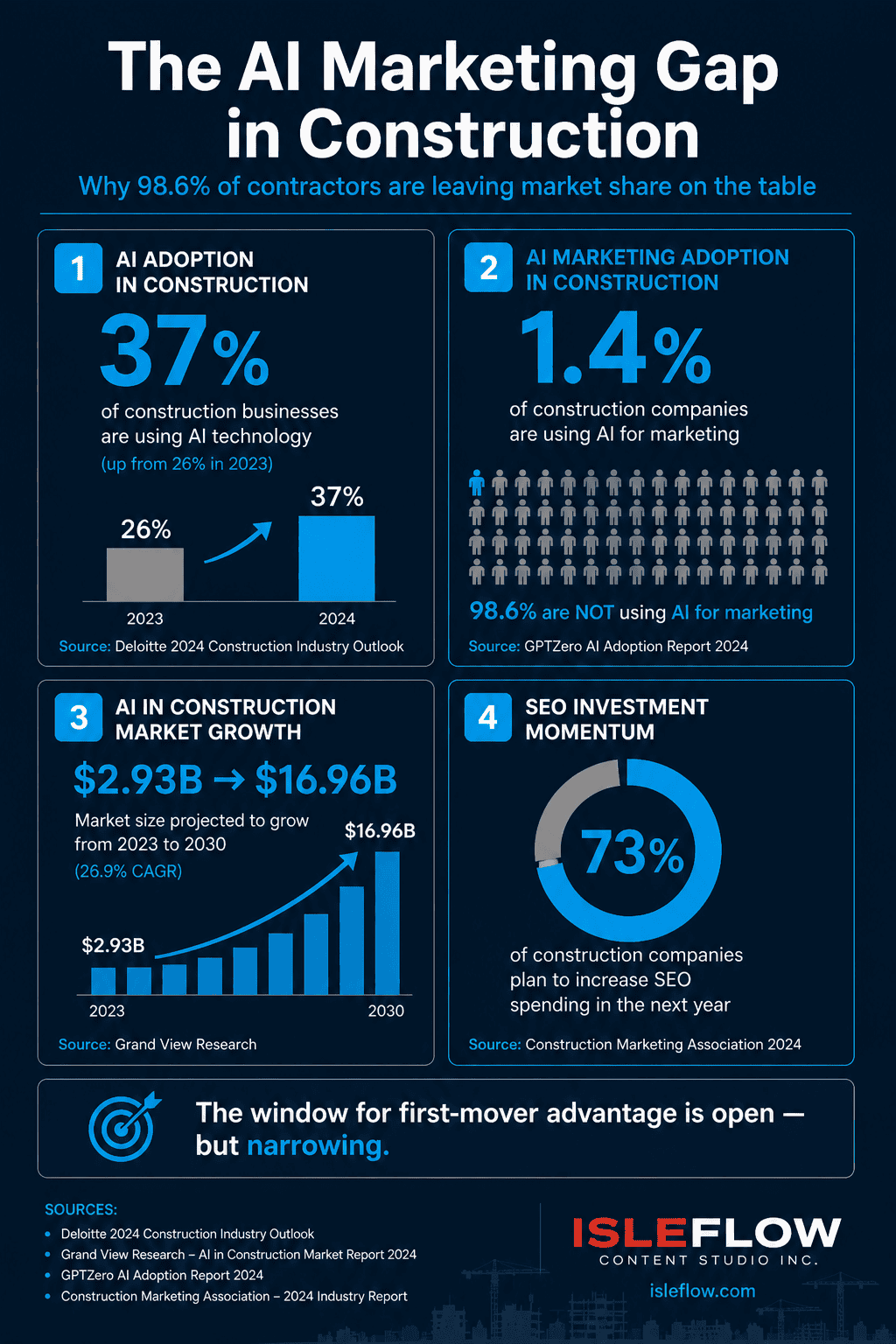
The gap between overall AI adoption and marketing-specific AI usage reveals a massive opportunity. While construction companies are implementing AI for project management, safety monitoring, and operational efficiency, very few are leveraging AI for marketing and client acquisition. This creates a significant first-mover advantage for construction leaders who understand AI search optimization.
How Does AI Search Optimization Create Competitive Advantages?
AI search optimization creates competitive advantages for construction companies by positioning them ahead of the 98.6% of contractors who haven’t adopted AI marketing strategies. Early adopters capture higher-intent leads through voice searches and conversational queries, while AI systems favor their comprehensive expertise over competitors using outdated keyword tactics. This results in enhanced local market authority, reduced bidding competition, and premium project opportunities as AI platforms recommend established experts over generic service providers.
What’s the difference between traditional SEO and AI search optimization for construction companies?
Traditional search engine optimization focuses on keyword targeting, backlink building, and technical website optimization. AI search optimization requires a fundamentally different approach that prioritizes comprehensive content, documented expertise, and natural language optimization.
Key differences for construction marketing:
Keyword targeting evolves to intent-based optimization that answers specific construction questions
Backlink quantity becomes less important than content authority and comprehensiveness
Page optimization expands to Answer Engine Optimization (AEO) for AI platforms
Local listings must integrate with voice search and conversational AI queries
Construction-Specific Competitive Advantages
Higher Quality Leads: When potential clients find construction companies through AI-generated responses, these leads show higher engagement rates. Research indicates that clicks from AI Overview results spend more time on websites because AI provides better context about the construction company’s expertise before the click occurs.
Local Authority Establishment: AI systems recognize expertise signals differently than traditional search engines. For construction companies, this means documented project experience, detailed case studies, and comprehensive service explanations perform better than keyword-optimized marketing pages.
Reduced Competition: While construction companies plan to increase SEO spending, most are still thinking in traditional SEO terms. Construction leaders who understand AI search optimization face significantly less competition for AI-generated search visibility.
Measurable Business Impact
Construction companies implementing AI-friendly content strategies report significant operational benefits:
Each additional technology adoption is associated with 1.14% revenue increase
Construction businesses using AI technologies save approximately 10.5 hours per week
McKinsey estimates AI could unlock $18 billion in value for home builders, roughly 10% of total industry revenues
AI-Powered Local Search Transformation
Local 3.0: AI-First Discovery
The evolution of local search for construction companies is happening in three distinct phases. Local 1.0 focused on basic directory listings and citation management. Local 2.0 emphasized Google My Business optimization and review management. Now, Local 3.0 represents AI-first discovery where conversational search and personalized recommendations replace traditional map pack results.
Local 3.0 for construction companies means AI systems provide personalized contractor recommendations based on project type, location, and past search behavior, moving beyond basic directory listings to intelligent matching.
AI systems personalize construction searches through:
Past search memory: AI systems remember previous construction-related queries to provide more relevant recommendations
Project-specific matching: AI understands the difference between residential renovation and commercial construction needs
Geographic nuance recognition: AI systems identify local building codes, climate considerations, and regional construction preferences
Real-time intent matching: AI matches current user needs with construction companies that specialize in specific project types
Your local SEO strategy must evolve beyond basic directory listings to include comprehensive content that helps AI systems understand your specific expertise, service areas, and project specializations.
Published Authority: The Ultimate AI Search Signal
Why Do AI Systems Prioritize Published Expertise?
AI search engines prefer comprehensive, authoritative content sources when generating responses to construction-related queries. Published authors with visible online content demonstrate exactly the type of in-depth, credible content that AI systems reference. Having a book demonstrates expertise and trust in the industry.
Benefits of published authority for construction AI search:
Comprehensive content depth: Books provide extensive coverage of construction topics that AI systems can reference
Lasting authority assets: Published content continues building credibility for years, unlike paid advertising that stops when spending ends
Enhanced credibility signals: Industry analysis suggests AI systems recognize published expertise as more authoritative than website content alone
Long-term investment value: One-time content creation provides ongoing AI search benefits without recurring costs
Construction professionals who have documented their expertise through published content create the type of comprehensive, authoritative material that AI systems prefer to reference. Unlike digital marketing campaigns that require ongoing investment, published expertise becomes a permanent authority asset that continues building credibility and AI search visibility over time.
AI Construction Marketing Implementation Strategy for 2026
Implementing AI search optimization for construction companies requires a systematic approach that builds on traditional SEO foundations while incorporating new strategies specifically designed for AI systems. This three-phase implementation ensures construction professionals can compete effectively in both traditional and AI-powered search environments.
Phase 1: Foundation – AI-Ready Content Infrastructure
Essential Technical Requirements:
Mobile-first design optimization is crucial because construction searches increasingly happen on mobile devices, often at job sites or during project meetings. Your website must load quickly and function perfectly on smartphones and tablets.
Page speed optimization for image-heavy portfolios is critical since construction websites typically showcase extensive project galleries. These visual assets must be optimized for fast loading without compromising quality, as AI systems factor page speed into their recommendations.
SSL certification and security measures provide essential trust signals, particularly important for construction companies handling large project budgets.
Structured Data Implementation:
Schema markup for construction companies should include:
Local business schema with specific construction service categories
Service area markup defining geographic coverage zones
Project portfolio schema for completed construction work
Review and rating markup to enhance credibility signals
Contact information schema for easy AI system access
Content Audit for AI-Friendly Formatting:
AI-optimized content structure requires:
Clear heading hierarchy (H1, H2, H3) that AI systems can easily parse
Bullet points and numbered lists for key information that AI can extract
Direct answers to common questions formatted for voice search optimization
Comprehensive topic coverage rather than keyword-stuffed thin content
Create detailed FAQ sections that address specific construction questions your potential clients ask, formatted as clear question-and-answer pairs that AI systems can easily reference.
Phase 2: Optimization – Search Experience Enhancement

Answer Engine Optimization (AEO):
AI systems prioritize content that provides comprehensive, authoritative answers to user questions. Create content that addresses specific concerns like:
“What should I look for when hiring a commercial contractor?”
“How long does typical office renovation take?”
“What permits are required for residential additions in [your city]?”
“How much does commercial construction cost per square foot?”
Construction-specific AEO strategies include:
Project timeline explanations with detailed phase breakdowns
Cost estimation guides for different construction project types
Permit and regulation information specific to your service areas
Material selection guides explaining construction options and trade-offs
Voice Search Optimization:
Voice searches for construction services use conversational language rather than keyword phrases. Optimize your content for questions like “Who’s the best contractor near me?” rather than “commercial construction company [city].”
Additional voice search optimization should target questions like:
- “How much does it cost to build a warehouse in [city]?”
- “What should I ask when interviewing general contractors?”
- “How do I verify a construction company’s licensing and insurance?”
- “What’s the typical timeline for commercial office renovation?”
Local voice search optimization should include:
Conversational service descriptions that match how people speak about construction needs
Geographic references using natural language rather than just city names
Project-specific terminology that matches how clients describe their construction requirements
Visual Search Preparation:
AI image recognition optimization requires:
Descriptive file names for all construction project images
Comprehensive alt text describing project details, materials, and scope
Image metadata optimization including project location, completion date, and construction type
Visual content organization that helps AI systems understand project categories
Phase 3: Advanced Implementation – Authority Content Creation
Comprehensive Expertise Documentation:
AI systems prefer comprehensive, detailed content that demonstrates extensive knowledge and proven experience. Create content that goes far beyond basic service descriptions.
Content types that AI systems prioritize:
Detailed methodology documentation explaining your construction processes
Comprehensive case studies with project challenges, solutions, and outcomes
Industry analysis and insights based on your construction experience
Educational content that helps potential clients understand construction processes
Authority Content Development Strategies:
Original research and data collection should include:
Local market analysis based on your construction experience
Industry trend documentation from your project work
Cost analysis and benchmarking for your service areas
Process improvement documentation showing your construction innovations
Construction professionals who establish themselves through detailed documentation of their expertise, methodologies, and industry insights create the type of content that industry analysis suggests AI systems reference most frequently when responding to construction-related queries.
Technical Requirements for Construction Websites
Core Technical Elements for AI Search Success
Website Architecture for AI Crawling:
Clear site structure with logical navigation that AI systems can follow
XML sitemaps optimized for construction service pages and portfolio content
Internal linking strategy that connects related construction topics and services
URL structure using descriptive, construction-relevant paths
Content Management for AI Systems:
Regular content updates to maintain freshness signals
Comprehensive topic coverage rather than surface-level information
Cross-linking between related construction topics to establish topical authority
User experience optimization that AI systems recognize as high-quality
Construction websites must balance visual portfolio requirements with technical performance. Industry research indicates that AI systems favor websites that provide excellent user experiences, making technical optimization crucial for AI search success.
Construction Business Results and ROI Considerations
Measuring SEO Success in the AI Search Era
Construction companies implementing AI search optimization strategies need comprehensive measurement approaches that track both traditional SEO metrics and emerging AI search performance indicators.
Traditional SEO Metrics Still Matter:
Organic traffic growth from search engines to construction service pages
Keyword rankings for location-specific construction terms
Local search visibility in map pack results and local directory listings
Conversion rates from organic search traffic to project inquiries and consultations
New AI Search Metrics:
Answer engine appearances: How frequently your content appears in AI-generated responses
Voice search capture: Performance in voice-activated searches for construction services
AI Overview inclusions: Visibility in Google’s AI Overview results
Conversational search visibility: Performance when users ask specific construction questions to AI systems
Investment Considerations
AI search optimization investment factors include:
Content development costs for creating comprehensive, AI-friendly content
Technical implementation for website updates and structured data
Authority building through published content: One-time investment with lasting returns
Training and tool costs for learning new optimization techniques
The authority content advantage is significant: Construction professionals who establish themselves through comprehensive published content often see enhanced performance across all digital marketing channels. Unlike paid advertising or recurring marketing expenses, documented expertise creates a permanent asset that continues building authority and generating returns year after year.
ROI Tracking and Measurement
Essential tracking tools include:
Google Analytics 4 for AI-driven traffic sources and user behavior patterns
Search Console monitoring for AI Overviews and enhanced search features
Local SEO tracking tools for Google Business Profile performance
Authority tracking metrics for measuring industry recognition
Construction companies should implement tracking systems that distinguish between traffic from traditional search results and AI-powered search features, as research suggests clicks from AI Overview results show higher engagement rates.
Future-Proofing Your Construction Marketing for AI Search Evolution
2026 AI Search Predictions
Voice Search Adoption Acceleration: Voice search usage for construction-related queries is expected to grow significantly, particularly for:
Mobile job site searches by contractors and project managers
Natural language project queries from clients
Technical specification searches about building codes and materials
AI Agents Making Decisions: The next evolution involves AI systems that don’t just provide information but actively make recommendations and decisions, including:
Enhanced qualification criteria for evaluating construction companies
Automated vendor selection creating contractor shortlists
Real-time capability matching for specific projects
Visual Search Technology Expansion: Visual search capabilities are becoming more sophisticated, allowing:
Project similarity matching through photos
Problem identification for finding specialists
Material identification and supplier matching
Preparation Strategies
Building Universal Authority Signals:
Comprehensive expertise documentation across multiple formats
Original research and data creation as reference materials
Multi-platform content distribution
Consistent professional positioning
Creating Evergreen Content:
Comprehensive construction guides explaining processes and best practices
Local market analysis covering trends and opportunities
Technical expertise documentation of methodologies and standards
Detailed case studies demonstrating capabilities and results
Developing Authentic Expertise:
Industry involvement documentation through associations and education
Peer recognition cultivation and professional relationships
Media and speaking opportunities as industry expert
Comprehensive knowledge sharing helping others understand complex topics
Building Long-term Authority in AI Search
E-A-T Signals for Construction Companies
Google’s E-A-T (Expertise, Authoritativeness, Trustworthiness) framework provides guidance for building authority that both traditional search engines and AI systems recognize.
Construction-specific E-A-T development includes:
Expertise demonstration: Comprehensive documentation of construction knowledge and specialized skills
Authority establishment: Recognition from peers, industry organizations, and clients
Trust building: Consistent delivery of accurate information and reliable project completion
Original Research and Thought Leadership
Construction professionals who create original research and industry data often see enhanced authority recognition. Research opportunities include:
Local market analysis of construction trends and opportunities
Industry best practices documentation
Performance benchmarking of different approaches and materials
Regulatory analysis providing guidance on codes and compliance
Thought leadership strategies involve:
Regular content creation sharing valuable construction insights
Industry participation in associations and conferences
Peer collaboration on projects and initiatives
Knowledge sharing through teaching and mentoring
The construction professionals who will dominate future search environments are those establishing comprehensive authority through documented expertise now. As AI search technology continues evolving, AI systems prioritize authoritative, comprehensive content from recognized experts.
Moving Forward
What’s next for construction leaders in the AI search era?
You’ve built a successful construction business through decades of expertise and smart adaptation to industry changes. AI search optimization represents another significant change that requires the same forward-thinking approach.
AI search is reshaping how potential clients discover and evaluate construction professionals. With 51% of search results now featuring AI Overviews and AI systems increasingly making recommendations rather than just providing information, the construction leaders who establish comprehensive authority through documented expertise will gain significant competitive advantages.
The strategic opportunity is clear: while only 1.4% of construction companies currently use AI for marketing, 73% plan to increase their SEO spending. This creates a unique window for construction professionals who understand that AI search optimization goes beyond traditional SEO tactics.
The construction professionals who will dominate AI search results are those who establish comprehensive authority through documented expertise. Unlike recurring marketing expenses, this type of authoritative content becomes a permanent business asset that continues working for decades. However, many construction executives recognize the value of documenting their expertise but struggle with the time and process required to create comprehensive authoritative content.
As AI search continues evolving, the construction leaders who establish documented authority through comprehensive content will gain significant competitive advantages. Whether through detailed case studies, industry research, or comprehensive expertise documentation, such as writing a book, the time to build authoritative content that AI systems can reference is now. The construction professionals who act on this opportunity today will dominate AI search results tomorrow.
Frequently Asked Questions (FAQ) About AI Construction Marketing
Q: How quickly can construction companies see results from AI search optimization?
A: Most construction companies see initial improvements in 3-6 months, with significant results typically appearing within 6-12 months as AI systems recognize enhanced authority signals and comprehensive content.
Q: What’s the biggest AI marketing mistake construction companies make?
A: Focusing only on traditional SEO tactics instead of creating comprehensive, authoritative content that AI systems prefer to reference when answering construction-related queries.
Q: Do small construction companies need AI marketing strategies?
A: Yes, especially since only 1.4% of construction companies currently use AI for marketing, creating significant first-mover advantages for smaller firms that implement AI optimization early.
Q: How much should construction companies budget for AI search optimization?
A: AI search optimization requires content investment rather than ongoing advertising spend. Most construction companies invest in one-time authority building through comprehensive content creation, which provides lasting returns unlike recurring ad expenses.
Q: Which AI marketing tools work best for construction companies?
A: The most effective approach focuses on creating AI-friendly content rather than specific tools. Construction companies benefit most from comprehensive content that AI systems can reference, such as detailed case studies, process documentation, and industry expertise.
Q: What’s the difference between AI SEO and traditional SEO for contractors?
A: AI SEO prioritizes comprehensive, authoritative content that answers specific questions, while traditional SEO focused primarily on keyword density and backlink quantity. AI systems evaluate expertise and authority differently than traditional search algorithms.
Ready to establish your authority and differentiate your construction business? At IsleFlow Content Studio Inc., we work with construction executives to publish professional books that differentiate you from competitors, command premium pricing, and create lasting industry authority. Our proven publishing process is designed for busy construction professionals who want to become published authors without disrupting their business operations.
We guarantee your satisfaction—if you’re not completely satisfied with your book, we’ll work with you until it meets your expectations.
About the author:
Robert Puharich is the founder of IsleFlow Content Studio and author of Building Brilliance. He helps construction firms build the trust, authority, and credibility that makes them the first call, not just another bid.
