LinkedIn Ghostwriting for Construction Executives

Table of Contents
- Why Silent Executives Lose Shortlists
- What Is a Judgment Post?
- Six Posts That Build Trust With Owners
- How to Write a Post That Gets Read
- Why Busy Executives Hire a Ghostwriter
- What If You Do Not Know What to Write?
- What Construction Executives Should Stop Posting
- How Often Should You Post, and How Do You Know It Works?
- Show the Thinking Behind the Work
- Frequently Asked Questions (FAQ)
Key Insights
- Potential buyers may not be in the market today, so the executive they remember when they are ready is the one who stayed visible.
- A Judgment Post shows how you reason through a real decision, which is proof that owners and developers cannot get from a capabilities page.
- If you do not know what to write, we ask the questions, and your answers become the posts.
Owners and developers research the executives behind a contractor long before they pick up the phone, reading the profile, scanning recent posts, and deciding within minutes whether this person understands the work. Most construction executives give those buyers nothing substantive to find, which leaves the decision to whichever competitor happens to be more visible.
LinkedIn ghostwriting for construction executives closes that gap by turning the judgment you have built over years of bids, jobs, and hard calls into posts that sound like you. By the time your next project reaches a shortlist, your name is already familiar and your reasoning is already on the record.
Why Silent Executives Lose Shortlists
The people who will hire your firm over the next few years are mostly not shopping today, a pattern LinkedIn’s B2B Institute calls the 95-5 Rule, which holds that roughly 95% of potential buyers are out of the market at any given moment. When one of them does enter the market, the firms they already know and trust come to mind first, and everyone else has to work to be considered.
Construction buying makes the pattern sharper, because a school board, a developer, or a hospital system may build only once every few years and the shortlist forms from names the team already trusts. If those buyers have never watched you explain a decision, you are asking them to accept your credentials on faith.
Visible expertise changes that dynamic. In the 2024 Edelman-LinkedIn B2B Thought Leadership Impact Report, 86% of decision-makers said they would be moderately or very likely to invite an organization that consistently produces high-quality thought leadership into an RFP process, yet only 38% of the organizations producing that content expected it to earn them an invitation.
Trust explains much of the effect, since nearly three in four decision-makers (73%) said an organization’s thought leadership is a more reliable basis for judging its capabilities than its marketing materials. The 2025 edition adds that more than 40% of B2B deals stall because of misalignment inside the buying group, which is why it helps when several people at the buyer already recognize your name.
LinkedIn builds the profile, and local SEO for construction companies captures the search.
What Is a Judgment Post?
A Judgment Post is a short LinkedIn post that shows how you reasoned through a real project decision, including what you weighed, what you chose, and why.
It is not a ribbon-cutting photograph or a thank-you to the crew, because those posts establish that the work happened without explaining why it went the way it did. Owners learn more about your competence from one candid account of a decision than from ten project announcements.
That is why the format suits executives who dislike self-promotion, since you are not claiming to be good at the work but showing the thinking, and the thinking is what a buyer is trying to evaluate.
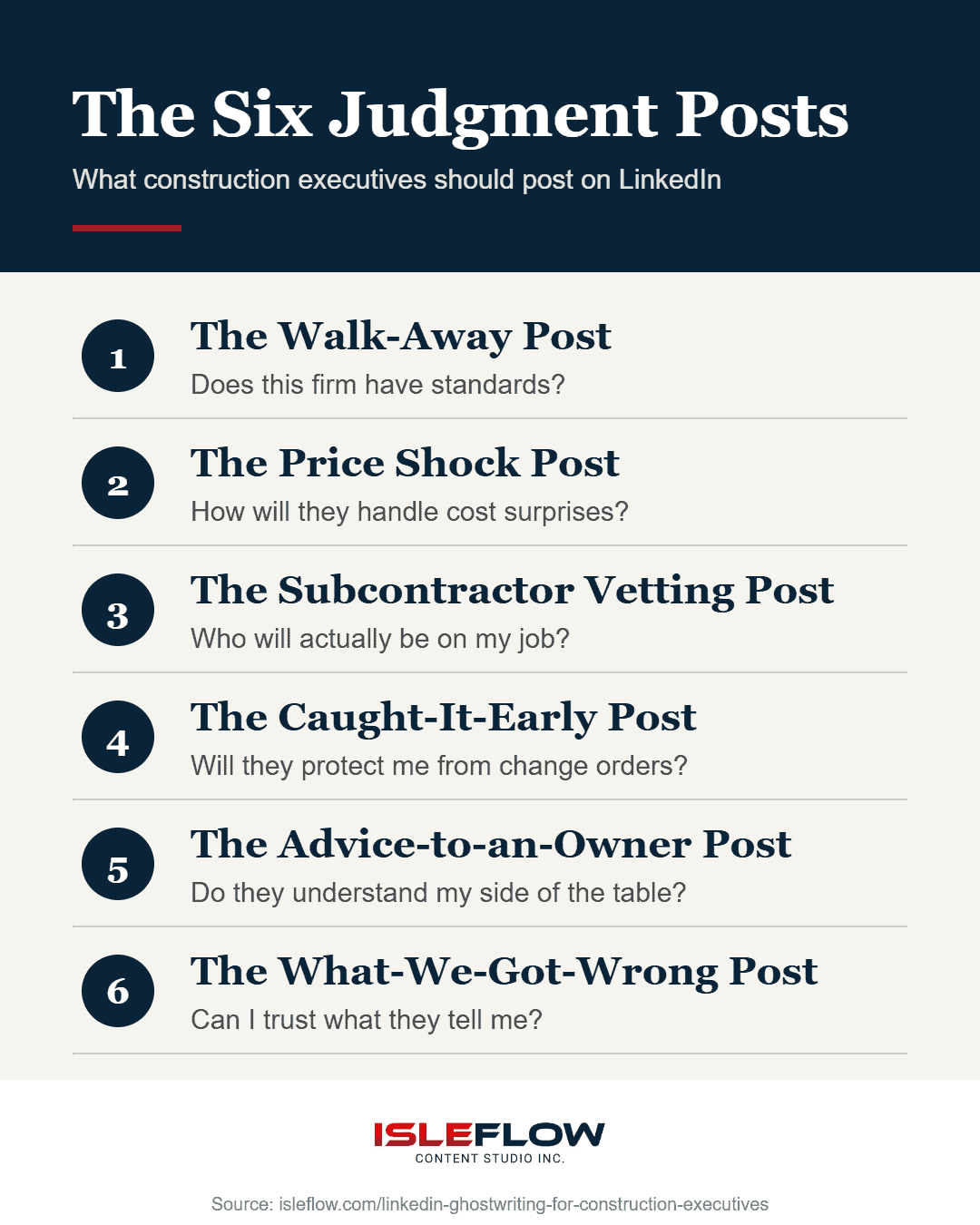
Six Posts That Build Trust With Owners
Six types of post cover most of what a buyer wants to know before awarding work, and each one begins with a decision you have already made.
The Walk-Away Post
This post explains a job you declined and the reasoning behind it, which tells owners that you protect your schedule and your standards and that you will not take on work you cannot deliver well. A strong opening is “We passed on a project last month, and the reason was not the price.”
The Price Shock Post
When material costs jump, owners want to know which contractor will tell them early and which will wait until the change order arrives. This post walks through how you explained a price change to a client and which options you put on the table, and it can open with “The number we gave in January was no longer true by March, so here is what we did.”
The Subcontractor Vetting Post
Owners worry most about the trades they never meet, so this post describes what you verify before hiring a subcontractor and what makes you walk away from a low bid. It can open with “I never award a trade package on price alone, and here is the first question I ask.”
The Caught-It-Early Post
Every experienced builder has a story about a problem found before it became expensive, and this post names the signal you noticed and the step you took, which shows that your team watches the work closely. One opening that works is “A small drawing conflict can cost weeks, so we look for it in the first coordination meeting.”
The Advice-to-an-Owner Post
Write the advice you would give an owner who asked what to lock down before breaking ground, which shows that you think about their risk and not only your own scope of work. You could start with “If I were the owner, here is what I would settle before the first shovel goes in.”
The What-We-Got-Wrong Post
Owners trust people who can describe a mistake without excuses, so this post names what went wrong, what it cost, and what changed afterward. A direct opening works well, such as “We underestimated the sequencing on that job, and this is what we do differently now.”
How to Write a Post That Gets Read
A post that gets read opens with the decision rather than the background, so the first line should tell the reader what happened or what you chose before it explains anything else.
Keep each post to a single decision and roughly 150 to 250 words, use short paragraphs so it reads cleanly on a phone, and close with the lesson an owner could apply to their own project.
Use the language you would use with a client across the table, including real trade names, project types, and numbers, because specifics separate a post a buyer believes from one they scroll past. Avoid naming clients or sharing confidential figures unless they have agreed, since protecting their information is part of what you are demonstrating.
Why Busy Executives Hire a Ghostwriter
Most executives know exactly what they would say if a client asked, yet the posts never get written because of three obstacles, which are limited time, the blank page, and a reasonable fear of sounding like a brochure.
Ghostwriting removes all three without changing a word of substance, since the ideas, decisions, and opinions still come from you while we handle the structure, the wording, and the publishing schedule.
The posts must sound like you or they fail, because an executive who came up through the trades does not write like a marketing department, and buyers can tell when a post was written by someone who has never been on a job site.
What If You Do Not Know What to Write?
You do not need a list of topics to get started, because we ask the questions and you answer them in your own words.
A conversation about your recent projects usually surfaces more material than you can use, particularly when it covers what you declined, what surprised you on a recent job, and what you would tell an owner who is about to build. Each answer becomes a post waiting to be written.
We also work from material you already have, such as proposals, project notes, and emails, and we write in your voice from there. You approve every post before it goes live, so nothing is published that you have not read and signed off on.
It is the same approach we take with a published book, where your knowledge stays the source and our job is to shape it so a buyer can absorb the point in under a minute.
What Construction Executives Should Stop Posting
Some posts cost you credibility because they tell a buyer nothing, and four kinds appear most often in executive feeds.
Generic congratulations and holiday greetings fill a feed without adding any information, and a buyer cannot tell your firm from any other based on them.
Photos of equipment, ribbon cuttings, and crew events show activity rather than thinking, so they work as supporting images but leave the buyer asking what you actually decided when they stand alone.
Recycled motivational quotes and engagement bait, such as asking readers for a like if they agree, signal that someone wrote the post for reach instead of substance, and owners notice.
Complaints about owners, designers, or other firms do the most damage, because a buyer reading them wonders what you will eventually say about their project. Keep anything critical for a private conversation.
How Often Should You Post, and How Do You Know It Works?
Two or three posts a week is enough for most executives, and consistency matters far more than volume, since a steady rhythm over six months builds more reputation than a burst of daily posts followed by silence.
Measure the signals that connect to work instead of the ones that flatter you. Likes are the weakest indicator, so watch for who views your profile, who comments with a real question, and who mentions your post in a conversation.
The strongest signal is a call that begins with “I saw your post.” Ask every new contact how they found you and keep a record, because after a few months that record shows which topics reach owners and which only reach peers.
Show the Thinking Behind the Work
Owners hire people they trust, and trust starts before the first meeting. A Judgment Post gives a buyer a reason to believe you before you ask them to.
You already have the material, because you make these decisions every week, and the real work is turning them into posts that sound like you and appear on a steady schedule. If that is the part that never happens, we can take it on, beginning with a conversation about your recent projects.
To see how this fits with the rest of your visibility, read our guide to the Commercial Authority Stack, or see how case studies turn finished projects into proof.
Frequently Asked Questions (FAQ)
What should a construction executive post on LinkedIn?
Post about decisions rather than announcements, since walk-away calls, price changes, subcontractor vetting, problems caught early, advice to owners, and corrected mistakes all show how you think. One honest decision explained in a few short paragraphs tells a buyer more than a project photo ever could. Start with the choices you make every week and write them down as they happen.
Can someone else write my LinkedIn posts?
Yes, and many executives prefer it because the ideas stay theirs while someone else handles the writing and scheduling. We interview you, read your own project material, and write each post in your voice. You review and approve every post before it is published, so nothing goes out that you have not signed off on.
How do you keep posts sounding like me?
We start from your own words, spoken in interviews and written in emails and proposals, so the vocabulary and the opinions are yours. Drafts come back to you for edits, and each round teaches us more about how you speak. If a sentence does not sound like something you would say on a job site, we rewrite it.
How much of my time does this take?
It takes far less time than writing the posts yourself, because you talk through your projects and decisions and then review the drafts while we handle the gathering, writing, revisions, and scheduling. The exact rhythm depends on how often you want to post, and we agree on it up front before anything is written.
Ready to put your experience in front of the people who hire? At IsleFlow Content Studio Inc., we write LinkedIn posts for construction executives from your real projects and your own voice, so your profile builds authority without taking over your week. Start a conversation and we will map out your first month of posts.
About the author:
Robert Puharich is the founder of IsleFlow Content Studio Inc. and author of Building Brilliance. He helps construction firms build the trust, authority, and credibility that makes them the first call, not just another bid.