
Awards Win at the Banquet. A Book Wins the Client.

Walk into the office of any established custom home builder and you will find the same wall. Framed award certificates. Regional builder of the year. Best kitchen over a certain budget. Housing excellence finalist, three years running. That wall represents real accomplishment, judged by people who understand the work. It also represents one of the most expensive misunderstandings in construction marketing.
The misunderstanding is not that awards lack value. It is that builders expect awards to do a job they were never designed to do. That job is winning the trust of a specific client, at the specific moment they are deciding who to hand their money to. Awards impress. They do not persuade. A book does both, and it keeps doing both for years after the awards banquet is over.
Key Insights
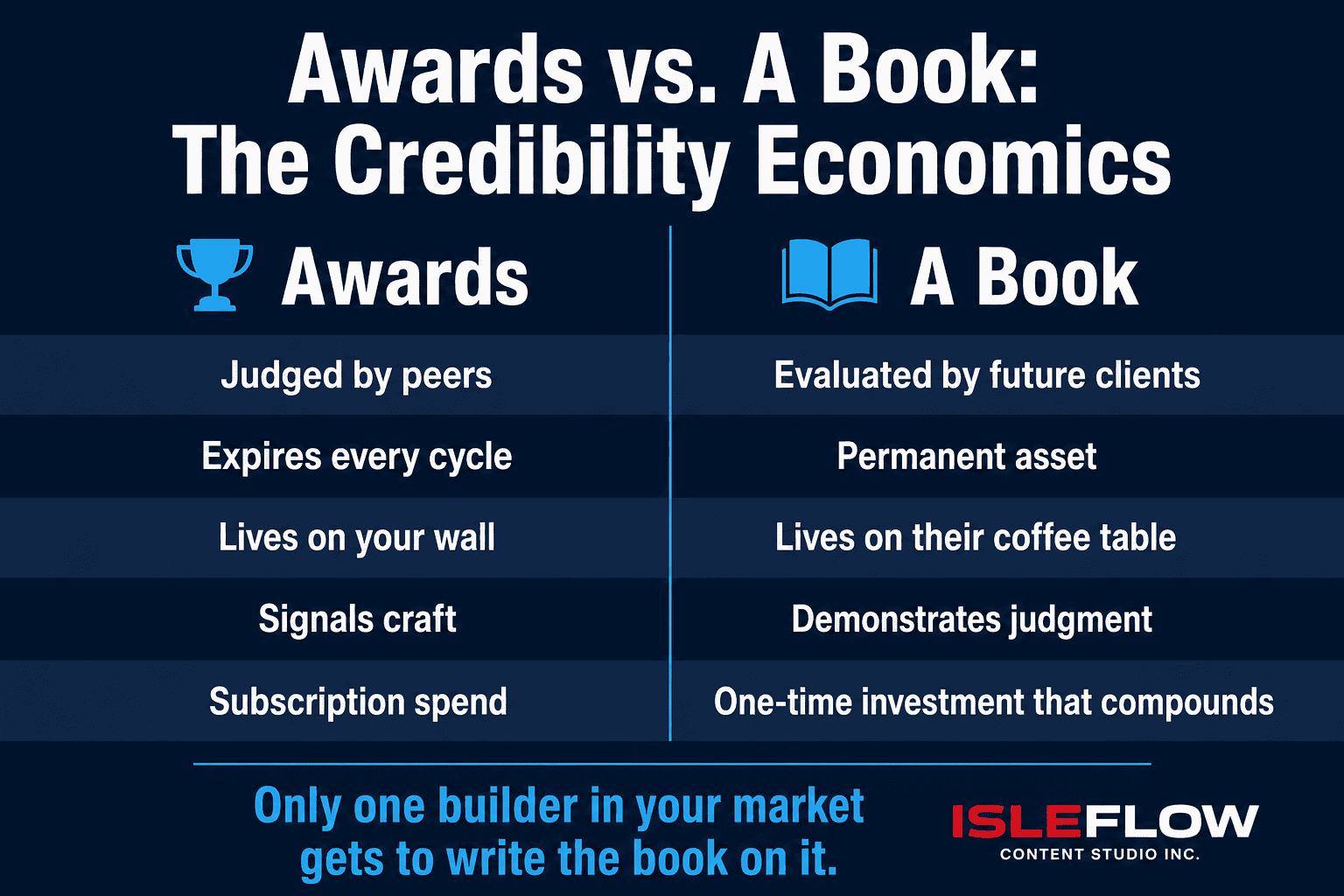
- Awards are judged by industry peers and expire with the award cycle. A book is evaluated by the only audience that matters, your future clients, and it never expires.
- An award tells a client that other builders respect you. A book shows the client how you think, which is what they are actually buying in a custom build.
- The builders who invest in awards are the exact builders who should publish, because they have already proven they will spend money on credibility. A book is the version of that spend that compounds.
What an Award Actually Tells a Client
An award tells a client three things. You entered. A panel of industry professionals liked the project you submitted. And you were better, that year, in that category, than the other firms that also entered. All of that is worth something. None of it answers the questions a client brings to a first meeting.
A family about to commit seven figures to a custom build is not asking which builder won best ensuite. They are asking harder questions. What happens when the budget meets reality? How does this builder handle the conversation nobody wants to have? What does their process protect me from, and what does it leave exposed? Will I still like working with these people in month fourteen? An award was never designed to answer any of those. It was designed to recognize craft, which is a different thing entirely.
An award cannot answer a single one of those questions. It compresses years of judgment into a logo on your website footer. The client sees the logo, registers a vague positive signal, and moves on to the next tab, where your competitor displays a nearly identical logo from the same awards program. The signal cancels out. This is the same dynamic we described in why capable contractors keep losing bids they should win. When credentials look identical, buyers default to price and gut feel.
The Shelf Problem
Awards have a second structural weakness. They expire. Builder of the year is a title with a date attached, and every year that date gets further from today. A 2021 award in 2026 raises a quiet question you do not want raised: what happened since?
So builders keep entering. New categories, new fees, new submission packages, every single year, to maintain a signal that resets to zero every cycle. Compare the economics honestly. An awards program is a subscription. You pay annually to rent credibility. A book is an asset. You build it once and it works every day after, in every market, without renewal fees.
The math deserves attention once. Entry fees across programs, professional photography for submission packages, the staff time spent preparing entries, and banquet and membership costs accumulate quietly into a number most builders have never added up. The spend continues every year because the signal expires every year. A book is a different kind of decision. You make it once, and what you produce works on your behalf in year one, year three, and year ten without a renewal notice arriving in your inbox.
There is also the matter of where each one lives. The award lives on your wall and in your Instagram highlight, where the client scrolls past it in under a second. The book lives on the client’s coffee table, in their hands, in the evenings they spend deciding who to trust. One of these occupies your space. The other occupies theirs.
What a Book Does That an Award Cannot
A book answers the questions the award ignores. It walks the client through your thinking before they ever sit across from you. How you handle allowances. Why your schedule holds when others slip. What you learned from the project that went sideways fifteen years ago and what you changed because of it. By the time a reader books a meeting, the trust conversation is mostly over. You are no longer being compared. You are being confirmed.
What that looks like in practice is a sales conversation that starts at a different point. The client who has read your book before the first meeting is not deciding whether to trust you. That decision was made on the couch the week before, probably in the evening when they had time to read. They arrive to confirm that you are the person you appeared to be in print, not to evaluate you against a list of competitors. The qualification work is already done. The builder’s job in that meeting is simply not to undo what the book built.
The research on this is consistent. In the Edelman-LinkedIn B2B Thought Leadership Impact studies, roughly three quarters of decision-makers say strong thought leadership makes them more likely to trust an organization, and a majority say it increases their willingness to pay a premium. Nobody has ever reported paying a premium because a builder had one more trophy than the firm down the road.
And there is a phrase clients use that no awards program can manufacture. He wrote the book on it. That phrase exists in the language because a book is the recognized shorthand for definitive expertise. Only one builder in your market gets to own it. As we covered in the highest-ROI construction marketing asset most firms overlook, the return on that position does not decay the way campaign spend does. It compounds.
The referral dynamic is different too. A satisfied client might hand your business card to one contact, if the right conversation comes up. The same client hands your book to three people, because a book is a considered gift, not a casual mention. And the person who received your book from a trusted friend arrives at the first meeting already predisposed. Someone they respect did the work of persuasion before you ever had to.
Award Winners Are Exactly Who Should Publish
Here is the part that should sting a little. If you have an awards wall, you have already made the decision that matters. You decided your credibility is worth investing in. You paid the entry fees, assembled the submissions, photographed the projects, and showed up to the banquets. You believe visibility converts to business, and you are right.
You simply put the investment into the format with the shortest shelf life. The same conviction, pointed at a book, produces an asset that introduces you to clients you have never met, in rooms you are not in, years from now. The award proves you can build. The book proves you can be trusted with the build. Clients hire the second thing. That is not a criticism of the conviction behind the award entries. The ambition, the investment, and the belief that being known as excellent will convert to business are all correct. The format is the only variable worth changing.
This is also the difference between being respected and being known. Most excellent builders are respected inside the industry and invisible outside it, a problem we wrote about in You Did the Hard Work. Nobody Knows. Awards deepen the respect. A book ends the invisibility.
The Objection: I Am a Builder, Not a Writer
Good. Books by writers about construction are thin. Books by builders about construction are useful, and useful is what sells homes. The knowledge is already in you. Twenty-plus years of client conversations, problems solved, and decisions defended is more raw material than most authors ever get.
The process does not require you to write. It requires you to talk, in structured interviews built around a builder’s schedule, the same way you would explain your process to a serious client. The writing, structure, editing, and publishing are handled for you. If you are evaluating how that works and who to trust with it, start with the ten things to know before you hire a book publisher.
The process is built for the way builders actually work. The core of it is a series of structured conversations that capture the decisions you make every day on the job: how you scope a project, how you protect clients from the unknowns they cannot see coming, what you have learned from the projects that tested you most. Those conversations become the manuscript. The expertise is yours. The architecture, writing, editing, and publishing belong to the team. The builder’s role is to show up and speak to what they know. That is also the only part that cannot be sourced anywhere else.
Frequently Asked Questions
Should a custom home builder write a book instead of entering awards?
It is not either-or. Awards build peer recognition and team morale, and they remain worth entering selectively. But if the goal is winning clients, a book outperforms awards because it is client-facing, permanent, and exclusive. Dozens of builders in a market can hold awards. Only one can be the builder who wrote the book on building there.
How does a book actually win construction clients?
Three ways. Before the first meeting, it converts research into trust, because a client who has read your thinking arrives predisposed to hire you. During the sales conversation, it acts as the leave-behind no competitor can match. And after the project, it travels through referral networks in a way a business card never will, because people hand books to friends.
How long does it take a builder to publish a book?
With an interview-based process, the builder’s own time commitment is measured in hours, not months. The knowledge is extracted in recorded conversations, then structured, written, edited, and published professionally. Most of the calendar time belongs to the publishing team, not the builder. A builder who can hold a candid conversation about their work has everything the process needs to begin.
What should a custom home builder’s book actually cover?
The strongest builder books are not portfolios. They are frameworks for how clients should think about a major build, written from the perspective of someone who has managed hundreds of versions of it. The most useful content covers the decisions clients did not know they needed to make before they started: how allowances work and why they become problems, what happens in preconstruction that determines everything downstream, how to tell the difference between a builder who manages risk and one who quietly transfers it to the client. A book that gives a prospective client a more sophisticated way of thinking about their project positions the builder as the person who provided that framework. When they are ready to hire someone, they tend to hire the person who taught them how to think about the job.
Related reading: our guide to construction content marketing, construction case studies that win commercial bids, and the commercial authority stack framework.
Ready to turn your track record into the asset clients actually hire? At IsleFlow Content Studio Inc., we work with builders and construction executives to publish professional books that differentiate you from competitors, command premium pricing, and create lasting industry authority. Our proven publishing process is designed for busy construction professionals who want to become published authors without disrupting their business operations.
We guarantee your satisfaction. If you are not completely satisfied with your book, we will work with you until it meets your expectations.
About the author:
Robert Puharich is the founder of IsleFlow Content Studio Inc. and author of Building Brilliance. He helps construction firms build the trust, authority, and credibility that makes them the first call, not just another bid.
