Tariff Season Rewards Contractors Owners Already Trust

Input prices for new nonresidential construction rose 7.1% from June 2025 to June 2026, while contractors’ bid prices rose only 3.5%. Construction tariffs are a major reason, with aluminum mill prices up 52.4% and steel up 16.9%. That is how tariffs affect construction bids. Projects that were feasible at 2025 pricing are being repriced at numbers no one budgeted for.
Some are being cancelled. Others are getting restructured before the first shovel breaks ground. Across commercial construction, owners are reviewing their shortlists with a seriousness they did not bring to the same exercise eighteen months ago.
Most contractors are focused on the operational response, renegotiating supplier contracts, hedging on material procurement, revisiting fixed-price exposure, looking for schedule efficiencies that might offset cost increases. That work is necessary, but it addresses only one of the two problems tariff pressure creates for commercial contractors.
The second problem is a selection problem. And for many firms, it is the harder one to solve quickly.
Key Insights
- Input costs for new nonresidential construction rose 7.1% in the year to June 2026, double the 3.5% rise in bid prices, so contractors are absorbing much of the increase.
- Best-value procurement weighs qualifications and past performance alongside price, which is why documented expertise can outweigh a lower bid.
- The Certainty Premium is the bid advantage that documented, visible expertise creates when market conditions push owners toward risk aversion.
How Tariffs Affect Construction Bids
When project costs spike, the instinct is to assume owners compete contractors harder on price. The reality is more specific than that.
Owners who are absorbing cost increases at preconstruction are recalibrating risk. A project that arrives at the contract stage with tariffs as high as 50% on steel, aluminum, and copper represents not just a budget problem but a performance risk. Every change order, schedule slip, or quality issue on a more expensive project has a larger financial consequence than the same event on a project priced two years ago.
For contractors operating on fixed-price or lump-sum agreements, material cost increases that were not priced in at signing are typically absorbed by the contractor, not recovered from the owner. That compression concentrates risk on one side of the contract, and concentrated risk changes how owners think about who they trust with the work.
The response to that elevated risk is not necessarily to drive down the price further, though some owners do attempt that. The more common response is to narrow the field to contractors the owner already has reason to trust.
Unfamiliar firms, regardless of their pricing, require the owner to extend credibility they do not have evidence to extend. When the stakes are higher, that extension becomes harder to justify.
This is not a new dynamic in commercial construction. Owners have always favored contractors whose capabilities they could verify. What tariff pressure does is compress the timeline.
A selection decision that might have played out over twelve months through familiarity and relationship-building gets made faster when costs are rising and project timelines are shifting. The informal shortlist that forms before any RFP is issued gets shorter, and the threshold for inclusion gets higher. The broader context of market pressures reshaping commercial construction makes this dynamic more urgent, not less.
The contractors who are still getting those shortlist calls are not necessarily the ones with the lowest overhead. They are the ones the owner already knows, whose past performance is visible, and whose expertise has been demonstrated in a form the owner can evaluate before the first conversation begins.
Price Is Only Part of the Score
There is a structural reason that unfamiliar firms struggle in a risk-averse market, and it shows up most clearly in how commercial owners formally evaluate proposals.
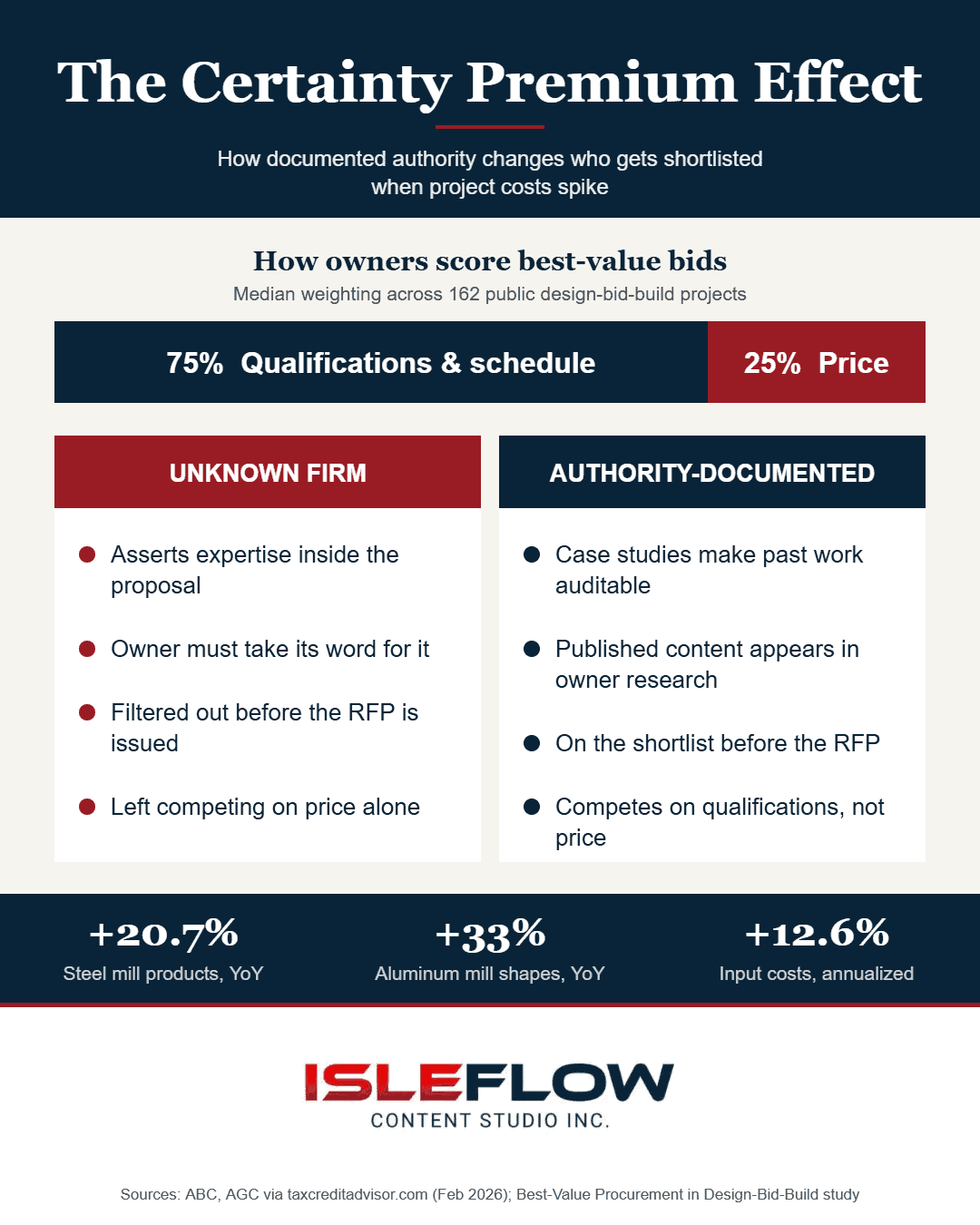
Owners who use best-value selection weigh qualifications, past performance, and technical approach alongside cost, and the AGC guide to best-value selection treats non-price criteria as a core part of the evaluation. That structure reflects the accumulated experience of owners who learned that the lowest proposal is often the highest risk.
Best-value procurement is the formal expression of something owners understood before the method had a name. Price matters, but the contractor’s ability to deliver what they priced matters more.
A firm that underbids and then struggles with coordination, subcontractor management, or unforeseen site conditions costs the owner far more in delay and rework than the difference between their number and the second-lowest bid. Owners who have been through that experience do not repeat it willingly.
In a tariff environment, where the material cost baseline is already elevated and the contractor’s margin for error on fixed-price work has narrowed, owners applying best-value criteria have even more reason to weight qualifications heavily. The risk profile of the project has gone up. That means the evidence standard for the contractor they select has gone up with it.
The practical implication is direct. In a market where material costs are rising and budgets are tighter, the competitive edge does not come from being 8% cheaper. It comes from being the firm whose qualifications are so clearly documented that cost becomes the secondary conversation.
The Certainty Premium
The Certainty Premium is the bid advantage that documented, visible expertise creates when owners are operating under elevated risk. It is not a pricing concession.
It is not a relationship discount. It is the structural advantage that accrues to firms whose capabilities are not merely asserted in a proposal but demonstrated in advance, in forms the owner can evaluate, share internally, and point to when explaining the selection to stakeholders.
The Certainty Premium operates in three directions at once.
First, documented authority reduces the owner’s research burden at the point of selection. An owner who has already read a published case study detailing how a firm managed a complex phased renovation, with the specific timeline, the coordination challenges, and the measurable outcome, has done their diligence before the proposal arrives.
The proposal confirms rather than persuades. That is a fundamentally different position to bid from.
Second, visible expertise elevates the firm’s perceived credibility in the period before formal procurement. Owners, developers, and their advisors research contractors before engaging them. A firm whose principal has published a book on commercial construction risk management, or whose technical team publishes substantive articles on the issues the owner is navigating, appears in that research.
Firms that do not publish do not appear. The informal shortlist is assembled, in part, from that background research, and it is assembled before the RFP is written.
Third, documented authority changes the reference dynamic in owner networks. When an owner asks a peer for a contractor recommendation, the peer is more likely to name a firm they associate with visible expertise than one they simply used without incident.
The article their advisor shared, the case study that circulated through a developer’s network, the book on the office shelf. These are the reference points that move a recommendation from “they did our last project” to “you should look at what they put out on this topic.” The Certainty Premium compounds with each published piece, and it accelerates when the market gets risk-averse.
What the Tariff Shock Exposed
The mechanism described above was not created by tariffs. It was always operating in commercial construction.
The firms that have appeared on shortlists consistently, project after project, have always had visible credentials that their competitors lacked. The ones who could not get in front of the right owners have always struggled to understand why the work went elsewhere when their qualifications were comparable on paper.
Tariff pressure did not change that dynamic. It clarified it.
When conditions tighten and the pool of viable projects shrinks, selection decisions that were once made generously become precise. The firm that was included on a shortlist as a fourth option, a fallback in case the top three were unavailable or over budget, is no longer included. The threshold for the informal list gets higher, and the firms that sit just below it find the calls stopping before they understand why.
The contractors who built documented authority before the current cost environment are not insulated from tariff-driven margin pressure. Their steel costs are rising too. What they did was separate that problem from the selection problem.
The tariff problem is operational and time-bounded. Material costs will eventually stabilize. The selection problem, the question of whether an owner knows who you are and trusts what you have done, is structural and long-standing.
Firms that treated authority-building as something to do after they won more work have discovered that the two are not sequential. The authority is what produces the next win.
What to Build Before the Next Market Shift
Every cost cycle eventually corrects. The current material cost environment will moderate. When it does, some firms will enter the recovery period having used the pressure to sharpen their operations, and some will enter it having done both, sharpening their operations and building the documented expertise that makes the next selection conversation easier.
Documented authority in commercial construction takes three primary forms, each serving a different stage of the owner’s evaluation process. Together, they form the documented authority foundation that separates firms on the shortlist from firms competing to get on it.
Published case studies make past performance auditable. An owner reviewing a proposal can follow a link to a structured account of a comparable project, including the specific challenge the contractor’s team solved and the measurable outcome the owner received.
That document does work the proposal itself cannot. It shows rather than tells, and it does so in a format the owner can share with advisors, partners, and internal stakeholders who were not in the room when the proposal was presented.
Thought leadership content, whether technical articles, whitepapers, or a consistent presence in the conversations owners are already having, makes the firm’s expertise visible before the formal procurement process starts. Owners and their advisors are researching contractors before issuing RFPs. A firm that appears in that research with substantive, expert-level content has already begun the qualification process before a single page of the proposal has been written.
A published book puts the executive’s expertise into a form that commercial buyers can reference, share, and cite in internal conversations. It is the strongest authority signal available because it is permanent, portable, and attributed. A case study gets filed.
A book gets kept. And in a market where owners are making more careful selections, the firm whose principal wrote the book on the type of project at hand is not starting from the same position as the firm that didn’t.
These assets do not protect against tariff-driven margin compression on current work. They address a different problem, which is the risk of not being on the list when the project that moves forward goes to shortlist. In a market where fewer projects are moving, being on that list is the only competition that matters.
How does documented authority affect construction bid outcomes?
Documented authority, including case studies, published content, and executive books, gives owners evidence they can evaluate before a proposal arrives. In best-value selection, qualifications and past performance are scored alongside price. A firm with visible, verifiable expertise lowers the owner’s perceived risk and is more likely to reach the shortlist before the RFP is issued.
What is the Certainty Premium in construction?
The Certainty Premium is the bid advantage that documented, visible expertise creates when market conditions push owners toward risk aversion. It describes the selection edge that firms with published case studies, thought leadership content, or executive-authored books hold over equally capable competitors who have not made their expertise visible. In a market where project costs are rising and the margin for error is shrinking, the Certainty Premium grows in proportion to how risk-averse owners become.
Are tariff impacts on construction materials recoverable on fixed-price contracts?
Generally, no. For contractors operating under fixed-price or lump-sum agreements, material cost increases resulting from tariffs are typically absorbed by the contractor rather than passed to the owner. This makes preconstruction pricing discipline and contract risk allocation more critical, and it increases the value of being the firm an owner selects first, before cost pressure prompts them to look for cheaper alternatives or reduce project scope.
How long does it take to build documented authority in commercial construction?
The timeline depends on the tool. A structured case study can be completed in weeks, a consistent thought leadership program builds visibility over six to twelve months, and a published book takes four months to over a year. None of these match the pace of a tariff shock, so firms that have not started should begin now, because the Certainty Premium is built before the market needs it.
Ready to establish your authority and differentiate your construction business? At IsleFlow Content Studio Inc., we work with construction executives to publish professional books that differentiate you from competitors, command premium pricing, and create lasting industry authority. Our proven publishing process is designed for busy construction professionals who want to become published authors without disrupting their business operations.
We guarantee your satisfaction. If you’re not completely satisfied with your book, we’ll work with you until it meets your expectations.
About the author:
Robert Puharich is the founder of IsleFlow Content Studio Inc. and author of Building Brilliance. He helps construction firms build the trust, authority, and credibility that makes them the first call, not just another bid.