
How to Write a Construction Case Study

Commercial buyers research contractors long before a formal solicitation is issued, and by the time an RFP reaches your firm the owner behind it has usually formed a shortlist from whatever evidence they could find on their own. A construction case study is the strongest piece of that evidence, because it shows how your firm thinks when a project gets hard. The problem is that most firms publish project profiles and call them case studies.
Learning how to write a construction case study means learning to write around the decision your team made under pressure instead of the building you delivered. This guide shows how to find that story, structure it, and keep it short enough that a busy buyer finishes it.
Key Insights
- Most construction case studies describe what was built, while buyers are looking for how your team handled a problem.
- The PSI Framework gives every case study three parts, a Problem, a Solution, and a measurable Impact, with your decision at the center.
- The best time to gather the story is within sixty days of completion, while the people who made the decisions still remember them.
What Most Construction Case Studies Get Wrong
Open almost any contractor’s website and you will find the same page, a photo of the finished building, a list of specifications, a project name, a location, and perhaps a dollar value. That is a project profile, and it answers a question no commercial buyer is asking. By the time an owner is researching your firm, they already assume you can build the type of project they have in mind.
What they cannot tell from a profile is how you behave when something unexpected happens, and something always does. The profile shows the end state, while a case study explains the path, including the coordination problem that surfaced in week six and the decision that protected the client’s schedule.
Many firms have delivered difficult projects with excellent outcomes and never documented the judgment behind them. That judgment stays invisible to every buyer doing pre-RFP research, which means it does no competitive work at all.
What Do Commercial Buyers Look for in a Case Study?
The shortlisting process in commercial construction is quiet. A project executive at a development firm looks up three or four general contractors, reads what is on each website, checks LinkedIn, calls a contact, and forms a view that decides who receives the invitation to bid.
Buyers reward evidence of expertise over descriptions of a company. In the 2024 Edelman-LinkedIn B2B Thought Leadership Impact Report, nearly three in four decision-makers (73%) said an organization’s expertise-led content is a more trustworthy basis for judging its capabilities than its marketing materials. A case study built around a real decision is exactly that kind of content.
Owners who select on value are trained to look past price as well. The AGC guide to best-value selection treats qualifications and other non-price criteria as a core part of how proposals are evaluated, so a buyer reading your case study is doing informally what a scoring committee does formally.
The question behind that reading is not whether you can handle a project of this size. It is whether you have already handled problems like the ones this owner is about to face, and how you handled them.
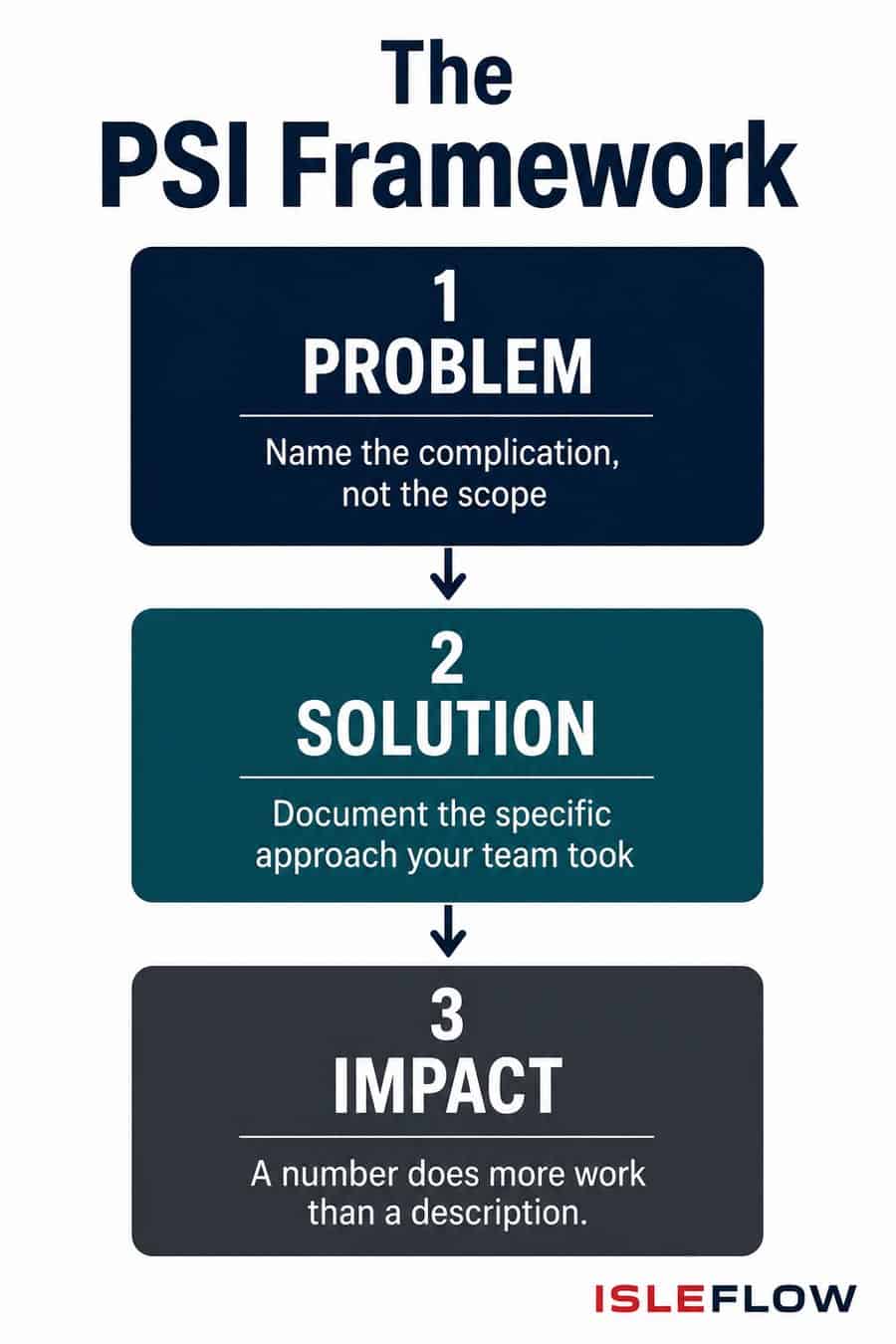
The PSI Framework for Construction Case Studies
The PSI Framework is a three-part structure for construction case studies that turns project experience into commercial evidence, made up of the Problem that required your team’s intervention, the Solution you designed and delivered, and the measurable Impact the client received.
It gives commercial buyers the structured proof they use to justify choosing a higher-priced firm over a lower-priced one in a best-value evaluation. A fuller five-part narrative version, the Recovery Story Format, adds project context and a closing implication for readers who want more depth.
The Problem
The Problem is the specific, high-stakes challenge inside the project scope, the complication that required your team to make a decision a less experienced contractor might have gotten wrong. Examples include a tight urban site next to occupied buildings, a mission-critical handover where delay would trigger downstream costs, or a soil condition found during excavation that forced a foundation redesign.
Write it specifically enough that a project manager with experience in that building type would recognize the situation immediately. Vague phrases such as scheduling challenges or coordination complexity give a buyer nothing to evaluate, so name the complication in two or three sentences without dramatizing it.
The Solution
The Solution describes the steps your team took, and it is where most firms write the least. A standard project description says the team managed the schedule closely and coordinated with the owner, which could describe any project ever built.
A strong Solution says the team restructured the work into four activation zones, kept a working perimeter around occupied operations, and added a daily close-out routine that removed the coordination lag between trades. Document the decision itself, including what you knew, which options you weighed, and why you chose the path you did, in three to five sentences.
The Impact
The Impact converts technical success into business value, and it is the part buyers weigh most heavily. A number does more work than a description, so substantial completion four days ahead of the revised schedule beats the phrase delivered on time.
Tie the result directly to the decision you documented, because that link is what turns a story into an argument. An evaluator who can trace the path from Problem to Solution to Impact does not have to wonder whether the outcome came from your competence or from favorable conditions.
How to Gather the Story From Your Project Team
Most firms do not lack strong projects. They lack a habit of asking the project managers, superintendents, and project executives the right questions at the right time, which is within thirty to sixty days of substantial completion. Wait much longer and the acute complication fades into a vague memory of some coordination issues.
Skip questions about scope and how things went. Ask what the biggest problem was and when you found out about it, which options you considered before choosing an approach, what would have happened if you had handled it differently, and what the client’s reaction told you about what mattered most to them.
Those answers produce the material that makes a case study credible. Some teams will hesitate to put a complication in writing, so explain that buyers will face complications on their next project no matter whom they hire, and the firm that can show its reasoning on a comparable one lowers the perceived risk.
Collect the plain facts at the same time, including the project value, your role, the delivery method, the original and actual completion dates, and a client contact who has agreed to be named. Proposal evaluators often ask for exactly these details, and having them on file saves hours when a bid deadline arrives.
Ask for photographs that support the decision and not only the finished building, such as the excavation that revealed the soil condition, the phased work zones, or the temporary protection around occupied space. A photo with a one-line caption that explains what the team was solving tells a buyer more than a polished exterior shot.
How Long Should a Construction Case Study Be?
A website case study works best at four hundred to six hundred words. A bid package insert can shrink to a single page, with each part reduced to two or three sentences, while a longer version of up to twelve hundred words suits a complication that involved several linked decisions and a technical audience.
Whatever the length, cut boilerplate about safety, quality, and client service that appears word for word on every contractor’s site. If a sentence could have been written without any knowledge of the specific project, it does not belong in the case study.
Mistakes That Weaken a Case Study
The most common mistake is writing for the firm instead of the buyer. Sentences about commitment to quality and a collaborative approach could appear on any contractor’s site, so they add length without adding evidence, and an experienced evaluator skims straight past them.
The second is burying the number. If the result was a four-day recovery or a cost avoided for the owner, put it in the first two sentences and again in the Impact, because a busy reader may never reach the bottom of the page.
The third is hiding the complication to protect the firm’s image. A project that went exactly to plan teaches a buyer nothing about you, while a documented setback and a sound response is the clearest proof of judgment you can publish.
Where Case Studies Fit in Your Authority Plan
Case studies are the base of the Commercial Authority Stack, the framework for how construction firms build procurement-relevant credibility. The layers above them, technical whitepapers, executive video, and a published book, all borrow some of their persuasive weight from the documented outcomes that case studies establish.
The goal is coverage, not volume. Three or four strong case studies across meaningfully different project types, complications, and delivery methods help a buyer more than twenty project profiles, because the buyer is trying to find one documented situation that resembles the one their next project is likely to produce.
For the wider picture of how this content earns attention before the bid, see our guide to construction content marketing, and for how firms get onto the list in the first place, read about getting on the shortlist before the bid.
Document the Decision, Not the Building
Buyers already believe you can build. What they want to know is how you think when the plan stops working, and a case study that records your decision, your reasoning, and a measurable result answers that before anyone picks up the phone.
Start with the most recent project that went off script. Interview the people who ran it, write the Problem, the Solution, and the Impact in plain language, and you will have the first piece of evidence that does real work in the shortlisting process.
Frequently Asked Questions
What is the difference between a project profile and a construction case study?
A project profile records what was built, including the scope, specifications, delivery method, and a photo of the finished work. A case study records how the project was navigated, specifically the complications that emerged and the decisions the team made in response. Profiles show that you have built comparable work, while case studies show that you can be trusted when something unexpected happens.
How many case studies does a construction company need?
Aim for coverage of the problems your target buyers are likely to face instead of a large number. Three to five strong case studies across different project types, complications, and delivery methods will outperform a long list of profiles. One case study documenting a real complication and a sound decision does more competitive work than ten projects that went exactly to plan.
Do I need the client’s permission to publish a construction case study?
Yes, ask for written approval before you publish, and check your contract for confidentiality terms. Many owners will approve a version that leaves out the contract value or uses a project description in place of a name. Raising the request near project completion, while the relationship is strong, makes approval far more likely.
How long should a construction case study be?
A website case study works best at four hundred to six hundred words, and a bid package insert can fit on a single page. Use up to twelve hundred words only when the project involved several linked decisions and the audience has the technical background to follow them. Every version should name the problem, the solution, and a specific result.
Ready to start building the case study library that earns your firm a place on the shortlist before the RFP is issued? At IsleFlow Content Studio Inc., we work with construction firms to develop Proof Layer case studies structured for the pre-RFP research process. If you have the project outcomes, we can document them at the standard that gives commercial buyers a credible basis for putting your firm on the shortlist before formal procurement begins.
We guarantee your satisfaction. If you are not completely satisfied with your content, we will work with you until it meets your expectations.
About the author:
Robert Puharich is the founder of IsleFlow Content Studio Inc. and author of Building Brilliance. He helps construction firms build the trust, authority, and credibility that makes them the first call, not just another bid.